For association executive directors and membership staff comparing tools for the first time, AMS, short for association management software, is often the first term that comes up in every vendor conversation, yet its meaning stays fuzzy.
This guide explains what AMS stands for, breaks down the core features and benefits of association management software, and shows how the right AMS reduces the manual work behind renewals, billing, and member records.
In short, the AMS meaning comes down to one idea: it is the system associations use to manage members, dues, and engagement in one place.
What Is AMS (Association Management Software)?
So what is association management software, exactly? AMS stands for association management software, a category of platform built specifically to run the membership side of an association: enrollment, renewals, dues billing, and member communication. A mid-size association might track thousands of member records across spreadsheets, a payment processor, and an email tool before adopting one, and consolidating those workflows into a single platform is usually the first operational fix a new membership director makes.
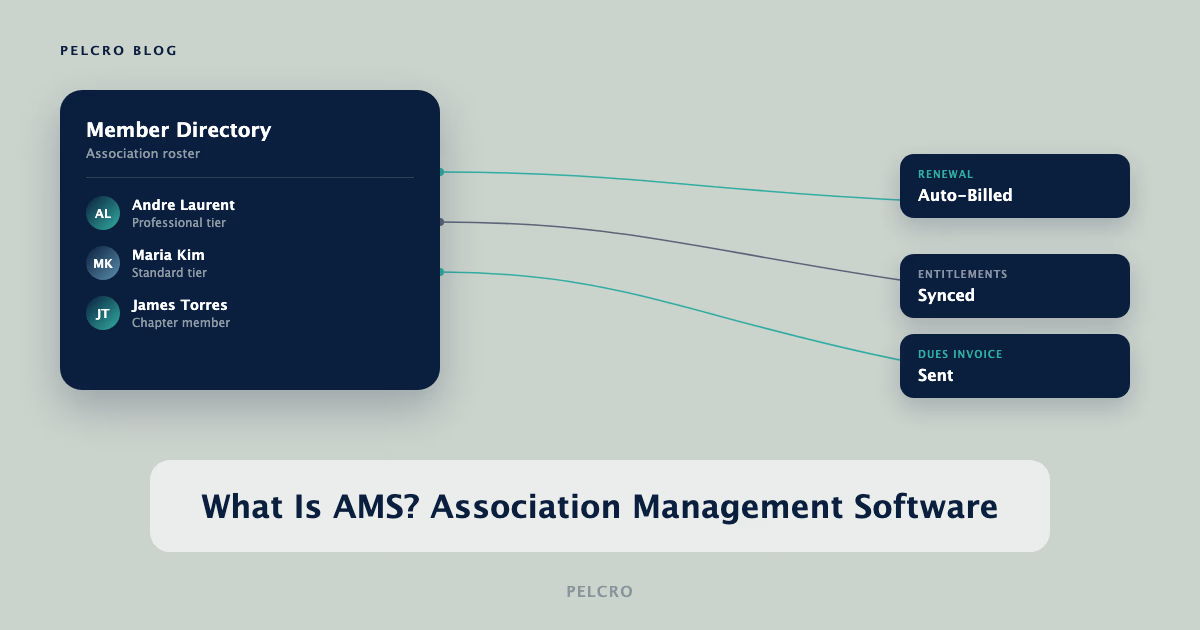
For staff, this software does the coordination work that used to sit across email threads and manual spreadsheets. It keeps a single member record that updates automatically when someone renews, upgrades a membership tier, or changes a billing method, so that record becomes the source of truth instead of three disconnected tools guessing at the same answer.
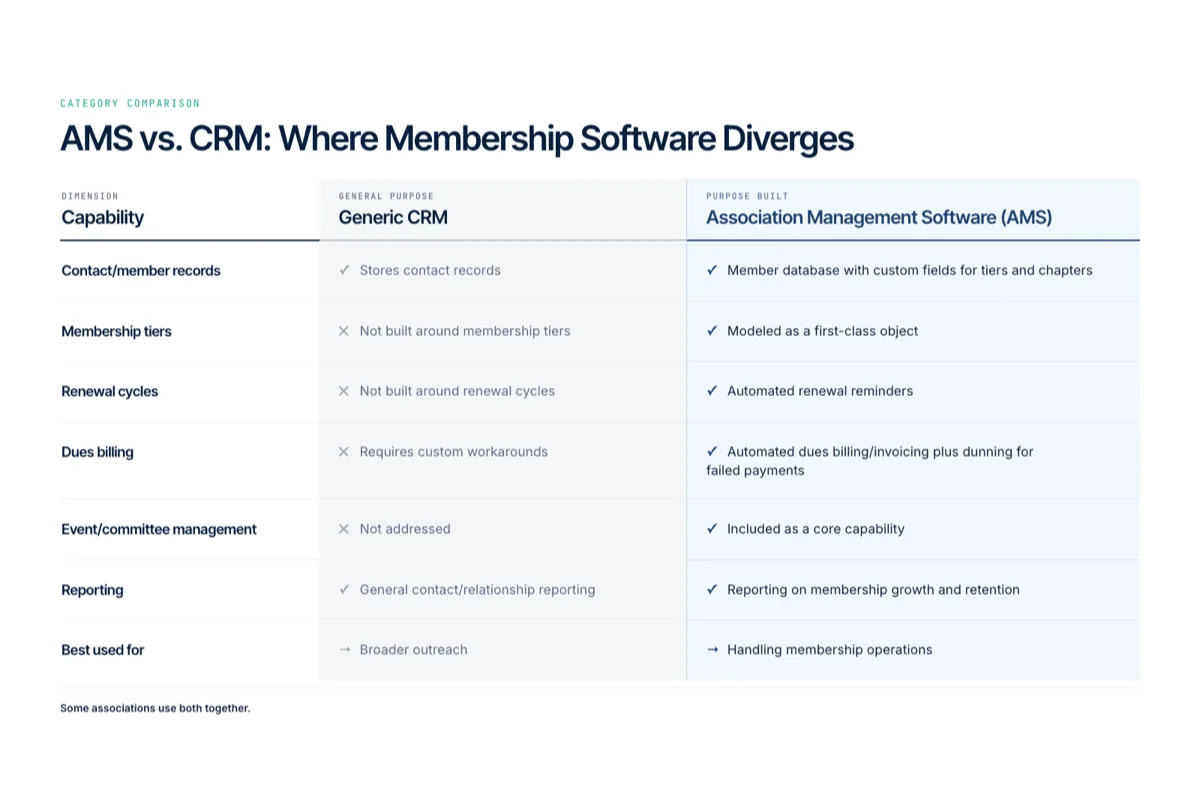
Generic CRMs can store contact records, but they were not built around membership tiers, renewal cycles, or dues billing, so associations that try to force a CRM into that role end up building custom workarounds. A purpose-built platform solves this by modeling membership as a first-class object: tiers, renewal dates, and entitlements live inside it, not bolted on as an afterthought.
Because dues renewals are the financial backbone of most associations, the billing layer matters as much as the member database. A system that handles recurring billing, dunning for failed payments, and automatic renewal reminders protects revenue that would otherwise slip through manual follow-up.
Core Features and Benefits of AMS
A real platform combines a few core capabilities: a member database with custom fields for tiers and chapters, automated dues billing and renewal reminders, event and committee management, and reporting on membership growth and retention. Association management software earns its name by tying all of these together instead of treating them as separate modules bolted onto a spreadsheet.
The direct benefit is time. Staff who used to spend hours reconciling renewal payments against a spreadsheet can instead let the system trigger renewal invoices automatically and flag the handful of accounts that actually need a phone call. A self-service portal also improves the member experience, letting members update their own payment details and renew online instead of mailing a check.
When evaluating options, the features that matter most are the ones tied to revenue and retention: automated dues billing, failed-payment recovery, and renewal reporting. A platform that only manages contact records without touching billing leaves the most time-consuming part of association management untouched.
Switching platforms is also a common trigger point. Associations usually move off a legacy system when renewal reconciliation starts eating a full-time staff role, when it cannot support a new membership tier without a support ticket, or when the reporting cannot answer a basic question like which members are at risk of lapsing. Those gaps are worth listing before a demo, since they turn a generic comparison into a checklist against the actual bottleneck.
How Pelcro Supports Associations Beyond Traditional AMS
Pelcro's association management software treats member data, billing automation, fulfillment, and engagement as equal parts of the same platform, so no single piece is left as an afterthought. Staff get a 360-degree view of each member, spanning subscription history, billing, and engagement, alongside automated dues invoicing and dunning that retries failed payments without manual follow-up.
Associations using Pelcro can manage multiple membership tiers, grant and revoke digital entitlements automatically when a membership status changes, and give members a self-service portal to update payment details, follow topics, and manage their own subscription. For chapters that still rely on physical mail, Pelcro also handles USPS address verification, NCOA updates, and presorting, so member benefits arrive without the fulfillment errors that a member-only database cannot solve on its own.
For associations that have outgrown a basic contact database or a CRM stretched past its limits, Pelcro's take on association management software gives staff one system for members, billing, and entitlements instead of several disconnected tools. See how Pelcro supports associations to manage members, automate renewals, and protect dues revenue.
Frequently Asked Questions
What does AMS stand for?
AMS stands for association management software. It refers to platforms built specifically to manage association memberships, including dues billing, renewals, and member records, rather than generic contact management.
What is AMS software used for?
AMS software manages the operational side of running an association: tracking who is a member, when their dues renew, what tier they belong to, and what benefits they can access. Most AMS platforms also handle event registration and committee management.
Is AMS the same as a CRM?
Not exactly. A CRM manages contacts and relationships generally, while AMS software is purpose-built around membership tiers, dues billing, and renewal cycles. Some associations use both together, with the AMS handling membership operations and the CRM handling broader outreach.
Do small associations need AMS software?
Any association managing recurring dues, renewals, or member benefits benefits from AMS, regardless of size. Smaller associations often see the fastest return, since manual renewal tracking becomes unmanageable well before staff expect it to.