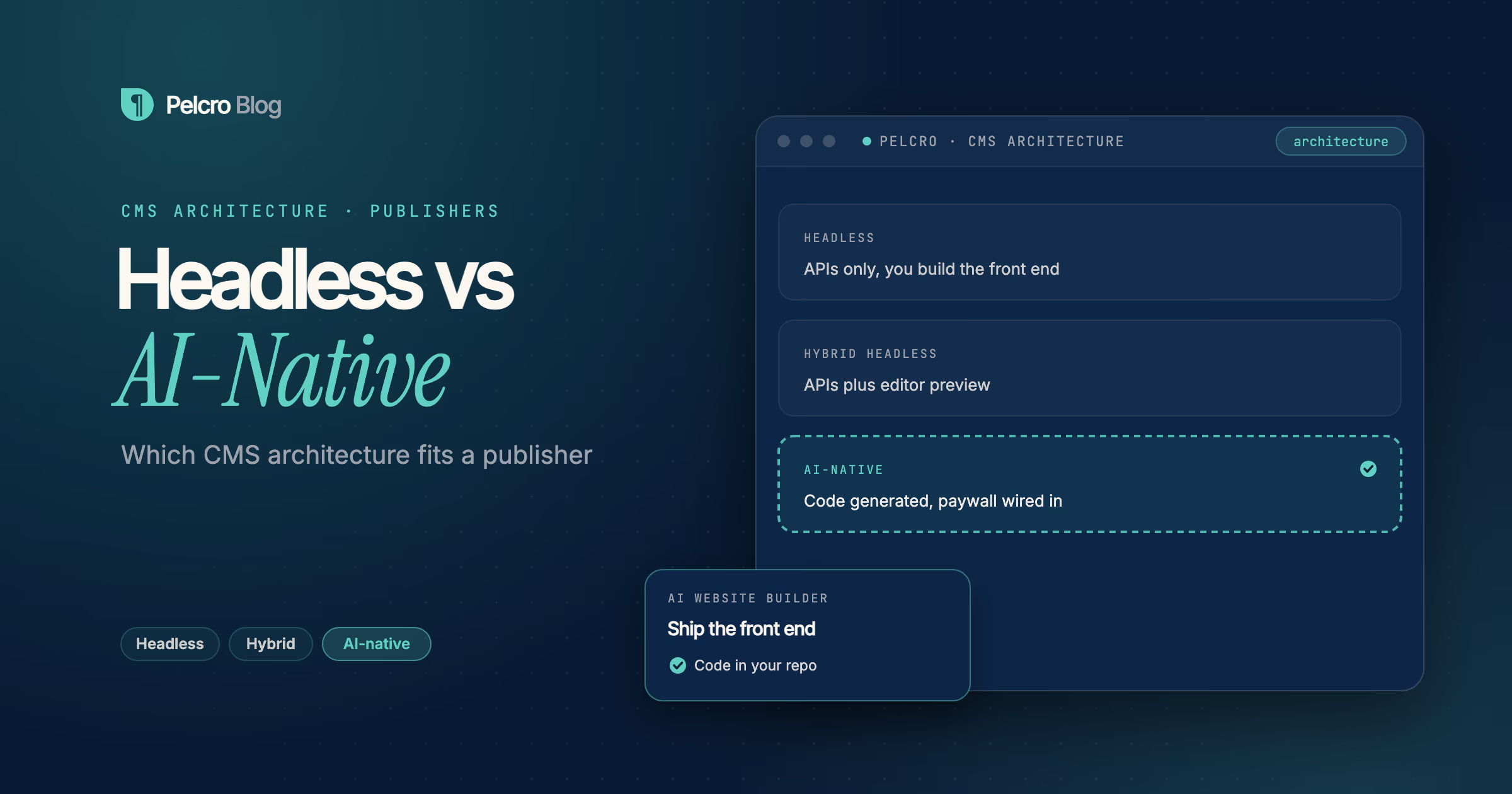
A headless CMS splits content from presentation: it stores and serves content through APIs, and a separate front end decides how readers see it. An AI-native approach starts from the other end, using an agent to build that front end as code your team owns, with the paywall and subscriptions wired in from the start. For publishers, the difference in CMS architecture is really about where your effort goes: modeling content for reuse, or shipping and owning the reader-facing site.
This guide is for publisher and engineering teams comparing CMS architecture. It explains headless, hybrid headless, and AI-native models, and how each handles the one thing a subscription publisher cannot skip: the paywall.
What is a headless CMS?
A headless CMS manages content without controlling how it is displayed. The content lives in a backend and is delivered through an API, usually REST or GraphQL, to any front end: a website, an app, a newsletter, or a smart display. The "head," meaning the presentation layer, is removed, which is where the name comes from.
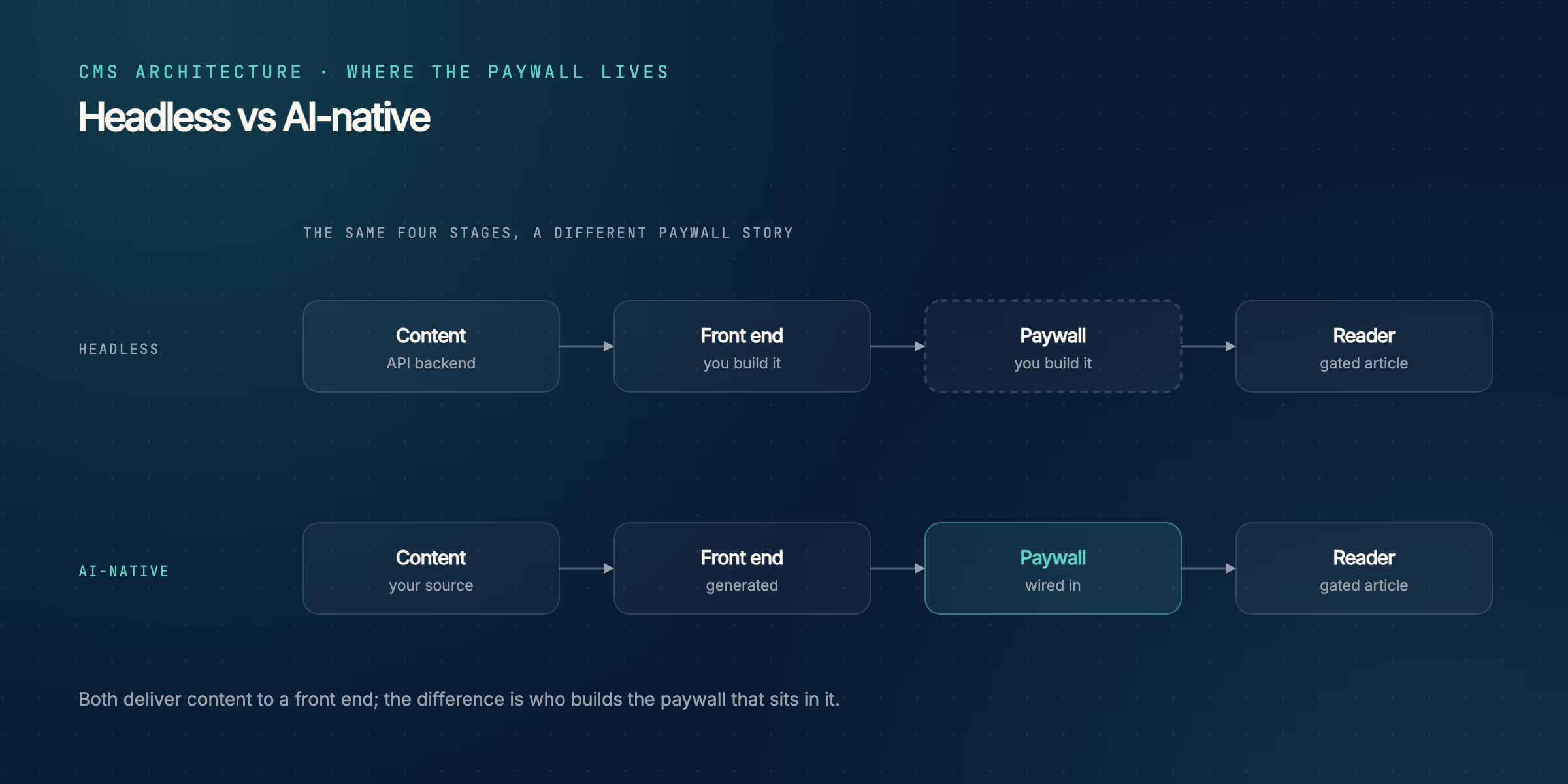
For publishers, the appeal is reuse and flexibility. One article can feed a website, an app, and a syndication partner without being re-authored, and the front-end team can use modern frameworks without being tied to the CMS's templating. The trade-off is that the CMS no longer gives you a finished site. Someone has to build and maintain the front end, including the paywall.
What is a hybrid headless CMS?
A hybrid headless CMS, sometimes called decoupled, tries to keep the flexibility of headless delivery while giving editors some of the convenience of a traditional CMS. The content is still available through APIs, but the platform also offers preview, visual editing, or built-in presentation options, so editors are not working blind against a pure API.
This matters for newsrooms because a fully headless setup can make everyday editing harder: an editor writing a breaking story wants to see the page, not a content tree. A hybrid headless CMS aims to serve both the API consumers and the editors from one system. The cost is more complexity in the platform, and you still own and maintain the front end that renders the reader experience.
What is an AI-native CMS?
AI-native is a newer idea than headless, and definitions still vary, so it is worth being precise. An AI-native approach uses an agent to generate the publishing site itself: you describe the templates, sections, and features you want, and the agent writes them as real code. Instead of configuring a platform, you get a site you own and can edit directly or change with another prompt.
Pelcro's AI Website Builder is an example aimed at publishers. It scaffolds article and section templates and a newsletter as ordinary code committed to your repository, wired to Pelcro from the first commit, and AI Studio, the agent for paywalls and checkouts, adds the metered paywall. It does not replace content modeling or an editorial backend if you need one; what it does is build and own the reader-facing site and the monetization around it, which is the part a headless CMS leaves to you.
How do the architectures compare?
The three models are points on a spectrum, not strict categories, but the differences are real.
| Consideration | Headless | Hybrid headless | AI-native |
|---|---|---|---|
| Content delivery | APIs only | APIs plus editor preview | Code the agent generates |
| Front end | You build and own it | You build and own it | Scaffolded for you, owned by you |
| Editor experience | API-first, can feel abstract | Preview and visual editing | Edit code or prompt the agent |
| Paywall | You implement it | You implement it | Wired in from the first commit |
| Best for | Multi-channel content reuse | Reuse plus editor comfort | Shipping and owning a monetized site fast |
None of these removes the need to think about content. A headless or hybrid headless CMS is strong when the same content feeds many channels. An AI-native build is strong when the priority is getting a monetized, owned site live without a large front-end project. Many publishers end up combining them: a headless backend for content and an AI-native front end that renders it and handles the paywall.
Which CMS architecture fits a publisher?
Start from how you publish and how you earn. If you syndicate content across apps, partners, and devices, headless or hybrid headless gives you one source of content for all of them. If your main job is running a website that converts readers into subscribers, the front end and the paywall are the hard part, and an AI-native build gets you there with less engineering.
For subscription publishers, the paywall is the deciding detail. On a headless or hybrid setup, the gate is something your team builds and maintains. With Pelcro, the paywall, billing, payment recovery, and print fulfillment run on one subscriber record, and the AI Website Builder can build the front end, or AI Studio can mount the gate into the one you have. See paywall and registration wall examples for the gating patterns themselves.
Give Pelcro AI Studio a paywall change
Frequently Asked Questions
What is a headless CMS?
A headless CMS stores and delivers content through APIs without controlling how it is displayed. A separate front end decides the presentation, so the same content can feed a website, app, or newsletter.
What is a hybrid headless CMS?
A hybrid headless CMS, also called decoupled, delivers content through APIs but adds editor conveniences like preview and visual editing. It aims to keep headless flexibility while making everyday editing easier.
What is the difference between headless and decoupled CMS?
In practice the terms overlap. Pure headless is API-only, while decoupled or hybrid keeps the API delivery but reconnects some presentation and preview features for editors. Vendors use the words differently, so confirm what a specific platform means.
What is CMS architecture?
CMS architecture describes how a content system separates or combines content storage, delivery, and presentation. The main models are traditional coupled, headless, hybrid or decoupled, and newer AI-native approaches that generate the front end as code.
What is an AI-native CMS?
An AI-native approach uses an agent to build the publishing site from a prompt as real code you own, rather than configuring a prebuilt platform. Pelcro's AI Website Builder takes this approach, and AI Studio wires the paywall and subscriptions to Pelcro.
Is a headless CMS good for publishers?
Headless suits publishers who deliver content to many channels and want front-end flexibility. The trade-off is that your team builds and maintains the reader-facing site and the paywall, which adds engineering work.
Do you still need a CMS with an AI-native approach?
You still need a way to manage content. An AI-native build handles the front end and monetization, and can draw content from a headless backend, a file-based system, or another source, depending on how you set it up.
Which CMS architecture is best for a small publisher?
Small publishers rarely need full headless complexity. A lighter setup, or an AI-native build that scaffolds the site and wires subscriptions, usually gets a small team to a monetized site faster than an enterprise content platform.
How does a paywall work with a headless CMS?
Because a headless CMS only delivers content, the paywall lives in the front end that renders it. The front end checks a reader's subscription status and gates the article, which is where a platform like Pelcro connects.