
The most useful paywall examples fall into seven patterns: metered, freemium, hard, and dynamic paywalls, plus the registration wall, the data wall, and the hybrid that chains a registration wall into a paywall. A registration wall asks for an email to keep reading, while a paywall asks for payment, and many publishers run both in sequence.
This guide is for audience and product teams at publishers deciding how to gate content. It walks through seven paywall and registration wall examples, what each one does, and when it fits, with a link to a live gallery you can browse.
What is a registration wall?
A registration wall, sometimes called a regwall, asks a reader to create a free account or submit an email before they keep reading. It trades content for a known contact instead of money, so the reader stays anonymous no longer and the publisher gains a first-party email to market to.
A paywall, by contrast, asks for payment. The two are often confused because they look similar on the page, but a registration wall builds an audience you can convert later, while a paywall converts now. Our guide to registration walls goes deeper on where the regwall fits.
Most publishers do not pick one wall and stop. They layer free, registered, and paid access so a reader meets the right ask at the right moment. The patterns below are the building blocks, and you can see live versions in the paywall examples gallery.
7 paywall and registration wall examples
Each example below is a pattern, not a single publisher. Match the pattern to your goal: reach, email capture, or revenue.
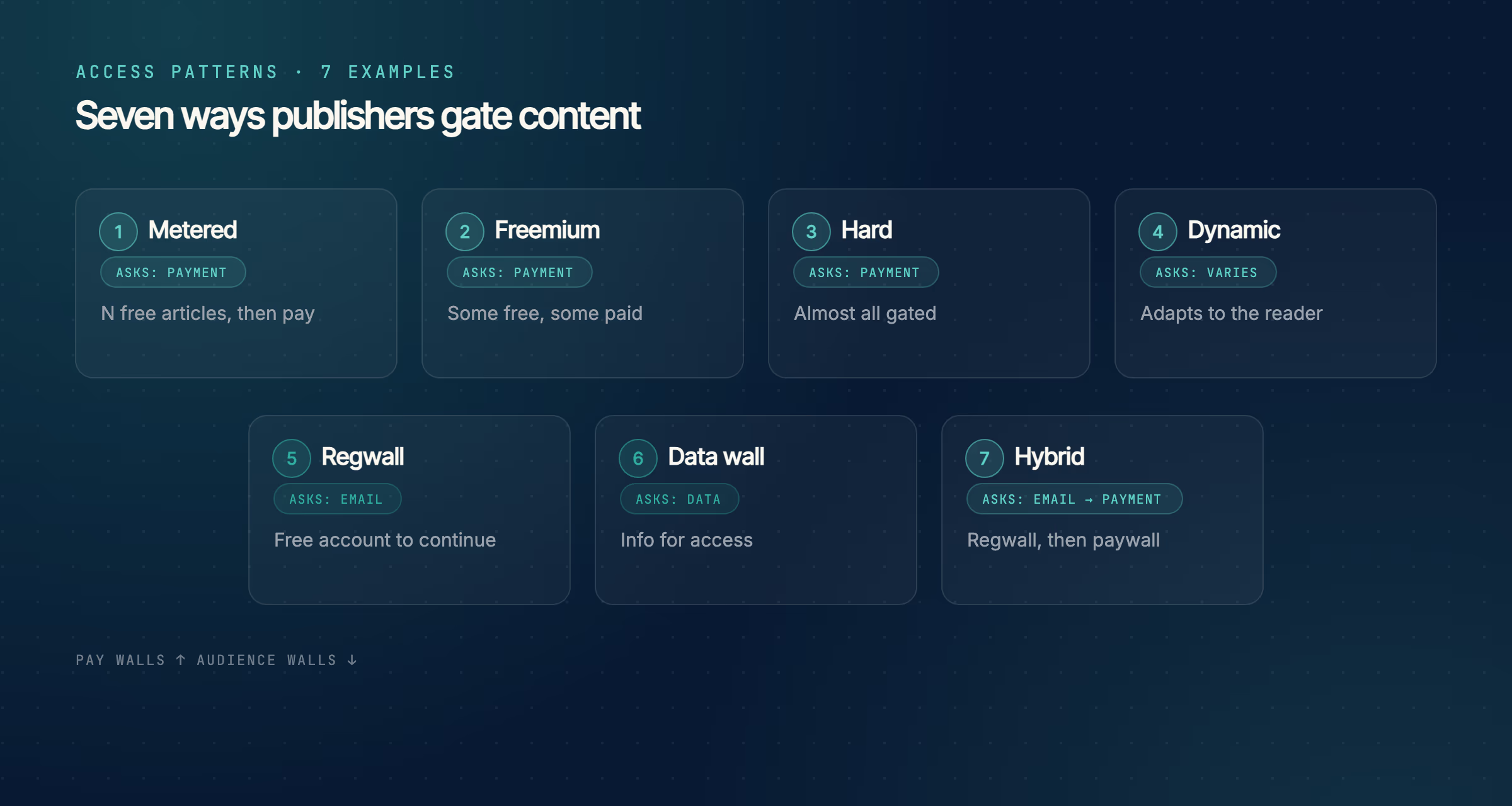
1. Metered paywall. The reader gets a set number of free articles, then hits the wall. A metro daily might allow five free articles a month before asking for a subscription, which protects reach while still converting your most engaged readers.
2. Freemium paywall. Some content is always free, and specific pieces are always for subscribers. A business title might keep news free and reserve investigations and data for paying members, signalling where the paid value lives.
3. Hard paywall. Almost everything requires a subscription, with little or no free access. This fits publications whose content is the whole product, such as specialist trade or financial titles, and trades reach for a clear value exchange.
4. Dynamic paywall. The ask adapts to the reader in real time, based on behaviour, source, or device. A dynamic wall might show a discount to a reader who lingers on the plans page, or a lighter ask to a first-time visitor from search.
5. Registration wall (regwall). Instead of payment, the wall asks for a free account or email. It is the standard way to turn an anonymous reader into a known contact you can email, retarget, and convert to paid later.
6. Data wall. A variant of the registration wall that asks for specific information, such as job title or interests, in exchange for access. It is common in B2B media where the audience data itself has value to the business.
7. Hybrid: registration wall into paywall. The reader reads free, then hits a registration wall, then a paywall. This staged approach captures the email first and only asks for payment once the reader is engaged, which usually converts better than leading with a hard ask.
Metered. Metered: the reader gets a set number of free articles, then meets a subscribe prompt.
How Pelcro builds paywalls and registration walls
Pelcro supports all of these patterns on its paywall, including metered, freemium, and hard walls, plus registration walls, with targeting by location, device, behaviour, URL pattern, and article tag. Because the wall sits on the same record as billing and identity, a reader who registers and later subscribes stays one person, not two.
The dynamic examples are where Pelcro differs most. Its AI coding agent builds custom paywall and registration-wall behaviour from a plain-language description, such as a countdown that reveals a coupon or a registration wall that upgrades to a paywall after three articles, on a branch with a preview link so nothing goes live until you approve it.
Search crawlers are detected so gated pages stay indexable, and print subscribers get digital access automatically. If you are still choosing a model, read metered vs premium vs dynamic paywalls, and browse working layouts in the paywall examples gallery.
Frequently Asked Questions
What is the difference between a paywall and a registration wall?
A paywall asks the reader for payment to keep reading, while a registration wall asks only for a free account or email. A registration wall builds an audience you can convert to paid later, so many publishers run a registration wall first and a paywall second.
What is a regwall?
Regwall is shorthand for registration wall, the gate that asks a reader to sign up for a free account or submit an email before continuing. It captures a first-party contact without asking for money.
Which paywall example works best for a news site?
Most news sites use a metered or dynamic paywall so they keep search reach while still converting loyal readers. A hard paywall suits publications whose content is specialized enough that readers expect to pay from the first article.
Can I combine a registration wall and a paywall?
Yes, and it is a common pattern. The reader reads a few free articles, hits a registration wall, and later hits a paywall, which captures the email first and asks for payment once the reader is engaged.