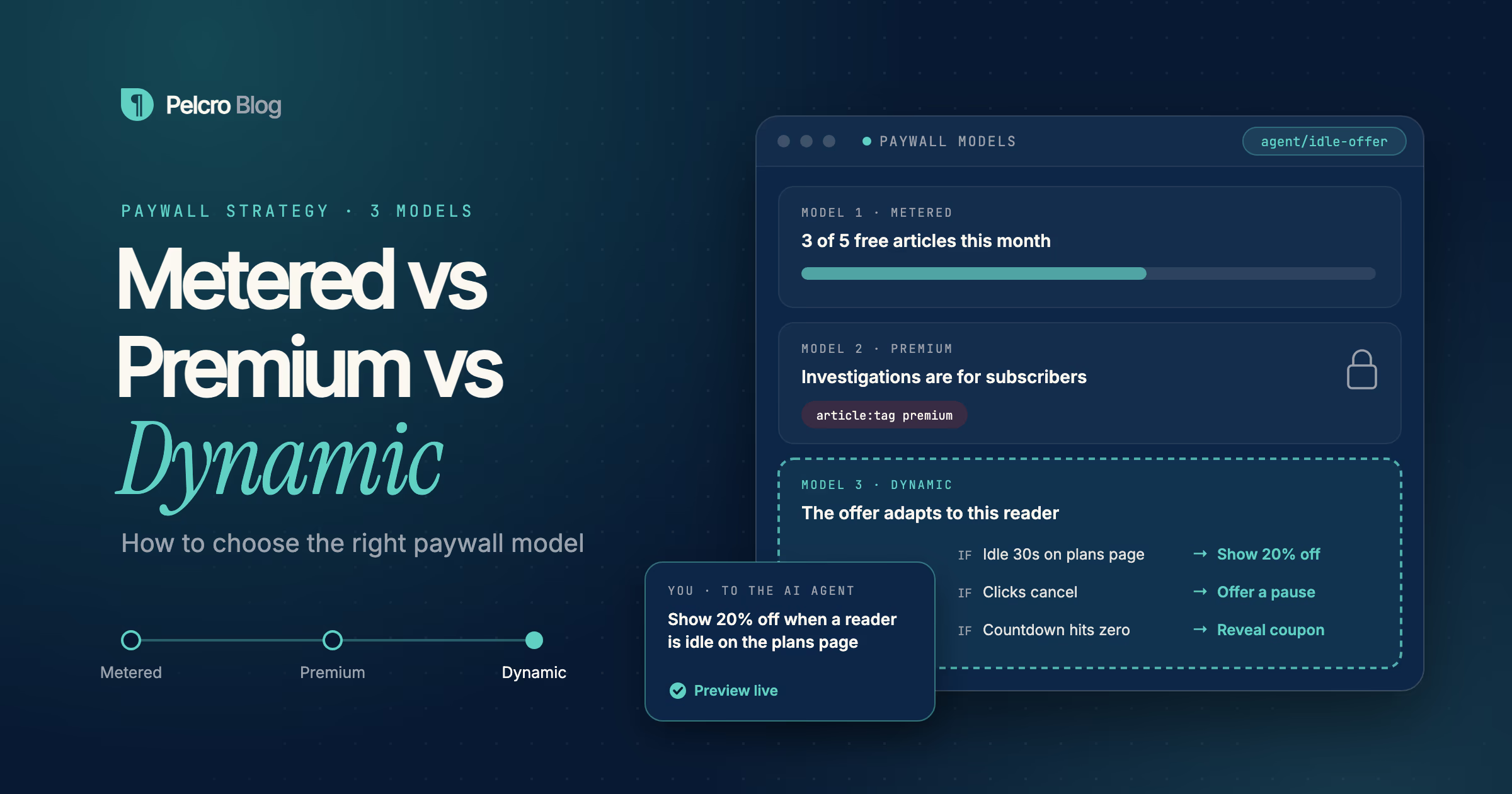
A metered paywall gives every reader a fixed number of free articles before asking them to subscribe, a premium paywall locks selected articles while the rest stay free, and a dynamic paywall changes the wall for each reader based on data about them. Metered suits publishers with a broad daily audience, premium suits publishers with a clear tier of exclusive content, and dynamic suits publishers with enough logged-in readers and traffic to personalize.
This guide is for audience, product and revenue leaders at newspapers and magazines deciding which paywall to run next. It covers how the three models work, what published research says about each, a decision framework by publisher size, content type and audience, and how Pelcro supports each model.
This guide is published by Pelcro. Last updated: October 13, 2026.
What is the difference between metered, premium and dynamic paywalls?
A paywall is the rule that decides which readers see which content before they pay. The metered vs premium vs dynamic paywall choice is really a choice about what that rule is based on: how much someone reads, what they read, or who they are.
Metered paywall. Every reader gets the same allowance, such as five free articles a month, and then hits the wall. The Google News Initiative lists The Atlantic, The New York Times and Nikkei among metered publishers.
Premium paywall. Also called freemium. Most articles are free and a chosen set is for subscribers only, whoever the reader is. The same playbook cites Le Monde and Politico as examples of this model.
Dynamic paywall. The wall adapts per reader. It might show an offer sooner to someone likely to subscribe, give a casual visitor more free articles, or change the price shown. The playbook describes it as showing offers more quickly to those with a higher likelihood to subscribe, while preserving pageviews.
A hard paywall, where nothing is free, is the fourth option. It works for publishers like The Wall Street Journal and the Financial Times, but it is rare. Reuters Institute research found hard paywalls extremely rare among US and European newspapers, with freemium and metered at 33% each in 2019.
Which paywall model works best: metered, premium or dynamic?
No single model wins everywhere, and the published evidence says so. The Shorenstein Center and Lenfest Institute put it plainly in their pay-meter study: there are no "right" meter limits to convert a reader.
What the research does show is a clear trend. INMA found that in 2020 only 5% of news sites in 33 countries used a hybrid or dynamic paywall. By November 2024, INMA reported hybrid or dynamic paywalls at 22% across 252 news brands, against 35% freemium and 27% metered among its Master Class attendees.
| Model | What triggers the wall | Best for | Main risk | Published evidence |
|---|---|---|---|---|
| Metered | Article count per reader | Daily news with broad, frequent readership | Most readers never reach the meter | Median publisher stops 1.8% of readers; thriving ones stop over 6% (Shorenstein and Lenfest, 2019) |
| Premium | Which article it is | Exclusive analysis, niche or B2B expertise | Weaker retention from premium-content signups | Premium converts may retain up to 20% lower than meter converts (GNI, Mather) |
| Dynamic | Data about each reader | Publishers with high traffic and many logged-in readers | Needs registration data and testing to work | Philadelphia Inquirer: 35% lift vs a control group (INMA, 2024) |
| Hard | Everything is locked | Must-have professional or financial news | Little free reach for search and social | Rare among newspapers (Reuters Institute, 2019) |
Metered paywalls: simple, but often too loose
A meter is easy to explain and keeps most content open for search and social traffic. The weakness is that most readers never hit it. The Shorenstein and Lenfest study found the median publisher stops only 1.8 percent of its readership with its paywall or meter.
The publishers with thriving digital subscription businesses stopped more than 6% of unique visitors. The same study found that a tighter meter limit led to a higher stop rate and more subscribers, and that most metered publishers set limits at five articles a month or lower.
Premium paywalls: strong for exclusive content
A premium paywall puts the subscriber line around the content readers can't get elsewhere. It suits publishers whose exclusive analysis, investigations or niche expertise is clearly different from the free news around it.
The trade-off is retention. The Google News Initiative, citing Mather Economics, reports that subscribers converted from premium content may retain as much as 20% lower than those converted from a traditional meter. Approaches also differ by region: European publishers designate about 35% of their content as premium, against about 10% for US publishers.
Dynamic paywalls: the highest ceiling, the most prerequisites
A dynamic paywall can beat a static one because it treats readers differently. At The Philadelphia Inquirer, a dynamic paywall drove a 35% lift in direct paywall subscriptions compared to a control group. INMA also reported that The Economic Times doubled its average subscription price while improving conversion by more than 15%.
The catch is data. Dynamic decisions are only as good as what you know about each reader, and INMA found the median news brand had only 8% of monthly users registered in the third quarter of 2024. The GNI playbook adds that a dynamic paywall makes sense if the incremental value exceeds the costs.
How do you choose a paywall model for your publication?
The metered vs premium vs dynamic paywall decision comes down to three things: your size, your content and your audience. Use the framework below as a starting point, then test, because the GNI recommends that all publishers looking to fine-tune their paywall meters run A/B tests.
| If your situation is | Start with | Why |
|---|---|---|
| Small local publisher, mostly local news | Metered, with a tight limit | Local news readers are 2 to 5 times more likely to subscribe than readers of national and wire stories (Shorenstein and Lenfest) |
| Mid-size regional newspaper with daily traffic | Metered plus premium tags on exclusives | Keeps search reach while locking the stories that convert |
| Magazine or niche publisher with deep expertise | Premium | Exclusive content is the reason to pay |
| Professional, financial or B2B audience | Hard or premium | Readers need the content for work, so free reach matters less |
| Large publisher with many logged-in readers | Dynamic | Enough data and traffic to personalize and to measure the lift |
| Any publisher with few registered users | Registration wall first, then dynamic | Dynamic rules need first-party data to act on |
By size. Smaller publishers usually get more from tightening a meter than from building a dynamic system. A dynamic paywall needs enough traffic to split into test groups and see a real difference.
By content type. If your best journalism is clearly exclusive, a premium wall makes that obvious to readers. If your value is the daily habit, a meter rewards frequency. Shorenstein and Lenfest found that readers of local news appear to be 2 to 5 times more likely to subscribe than readers of national and wire stories.
By audience. Most readers are casual. The same study found 68% of readers view only one article in a thirty-day period. The paying audience is a small, loyal group: the Reuters Institute Digital News Report 2026 found 17% of people pay for online news across 20 countries, with Norway at 40% as the outlier.
Whichever way the metered vs premium vs dynamic paywall choice goes, plan for payment recovery as well. A subscriber you convert and then lose to a failed card is a cost, not a win. Our guide on how publishers reduce failed payments and involuntary churn covers that side, and our comparison of paywall software for publishers covers the vendors.
How does Pelcro support metered, premium and dynamic paywalls?
Pelcro's paywall software supports metered, freemium and hard paywalls, configured without code. Targeting rules decide where each wall appears, so a publisher can meter daily news and lock exclusive stories behind a premium tag.
Metered and premium. Teams set meter limits and choose which content sits behind the wall. Pages can be targeted or excluded by URL pattern, and articles tagged with an Open Graph article:tag can be gated as a premium vertical.
Fully dynamic paywalls with the AI coding agent. Pelcro's AI coding agent works like a website builder for paywalls. Describe a behaviour in a sentence and the agent builds it on a branch with a preview link: a countdown that reveals a coupon, a discount shown when a reader sits idle on the subscription page, or a save offer when a subscriber tries to cancel. Built-in targeting by location, device and reader behaviour, plus custom JavaScript conditions, covers the common cases without code, and readers see plans in their own country, language and currency.
Testing and measurement. Paywall A/B tests compare plans, pricing, messaging and targeting rules by conversion.
Search and enforcement. Pelcro detects search crawlers such as Googlebot and Bingbot and disables the paywall for them, so gated articles stay indexable. Paywall state is exposed through cookies so publishers can validate access server-side.
Because the paywall runs on the same platform as billing and print fulfillment, a reader's access follows their subscription automatically. That includes print subscribers who get digital access as part of a bundle, which is covered in our guide to newspaper subscription management software.
When Pelcro isn't the right fit. If you want a vendor's propensity model to score every reader and set prices automatically, look at vendors whose product is built around that engine. With Pelcro, your team designs the dynamic behaviour and the AI coding agent builds it. If you already have a billing system you are happy with and only need a paywall layer, a standalone paywall may also be simpler.
Frequently Asked Questions
What is the difference between a metered and a premium paywall?
A metered paywall limits how many articles anyone can read for free, regardless of which articles they are. A premium paywall locks specific articles for everyone and leaves the rest free. Metered rewards frequent readers, while premium sells access to your most exclusive content.
Is a dynamic paywall better than a metered paywall?
It can be, if you have the data and traffic to run it. The Philadelphia Inquirer reported a 35% lift in direct paywall subscriptions against a control group. But INMA found the median news brand had only 8% of monthly users registered in 2024, which limits what a dynamic paywall can personalize.
How many free articles should a metered paywall allow?
There is no universal number, and the Shorenstein and Lenfest study says so. It did find that most metered publishers set limits of five articles a month or lower, and that a tighter meter led to more subscribers. Test different limits on your own audience.
What share of people pay for online news?
The Reuters Institute Digital News Report 2026 found 17% across 20 countries, down from 18% in 2025. Norway (40%) and Sweden (32%) are outliers, while the UK is at 10% and the US at 16% after a repoll.
Can a publisher combine paywall models?
Yes, and many do. INMA counts these as hybrid models, grouped with dynamic paywalls at 22% of news brands in its 2024 research. A common setup is a meter on daily news with premium tags on exclusive stories.