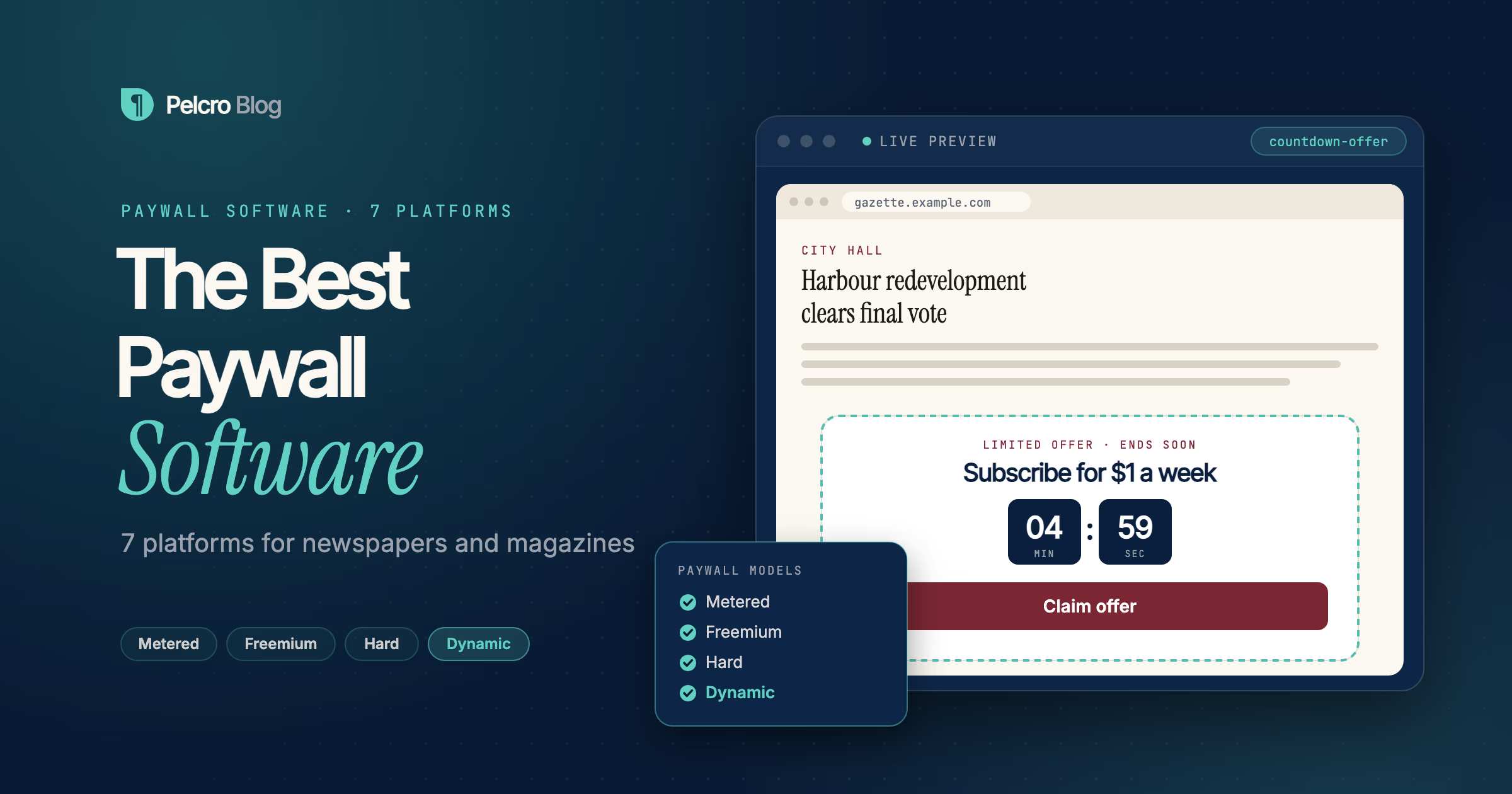
The best paywall software for a newspaper or magazine depends on what else you need it to do. Piano suits large media groups that want analytics and a CDP in the same suite, Zephr suits publishers already billing in Zuora, Poool suits European digital publishers adding walls to an existing stack, Admiral suits ad-supported sites that need adblock recovery, Leaky Paywall and Wallkit suit WordPress publishers that want published pricing, and Pelcro suits publishers that want fully dynamic paywalls, built by an AI coding agent, on the same platform as billing and print fulfillment.
This guide is for audience, product and revenue teams at newspapers and magazines choosing or replacing paywall software. It compares seven platforms on which paywall models they support, how they price, how they handle billing and print, and where each one is the right or wrong choice.
This guide is published by Pelcro. Every claim about another vendor was checked against that vendor's own website on October 13, 2026. Last updated: October 13, 2026.
What is paywall software?
Paywall software decides which readers can see which content, and asks the rest to register or subscribe. A metro newspaper might give anonymous readers five free articles a month, ask them to register for two more, and then show a subscription offer.
Good paywall software does more than block content. It runs the offers and checkout, tests prices and messages, recognizes subscribers on every device, and keeps gated pages indexable by search engines. For a publisher, it is the point where reader attention turns into reader revenue.
The tools differ most in what sits around the wall. Some paywall software is a decision layer that plugs into a separate billing system. Some is a WordPress plugin. Some, including Pelcro, run the paywall on the same platform as billing, subscriber management and print fulfillment. Which shape you need depends on the rest of your stack.
What is the best paywall software for newspapers and magazines?
There is no single best paywall software, so the seven platforms below are grouped by the publisher each one fits best, not ranked. Start with the two tables, then read the profiles for the vendors that match your situation.
| Platform | Metered | Freemium | Hard | Dynamic | AI agent builds your paywall |
|---|---|---|---|---|---|
| Pelcro | Yes | Yes | Yes | Yes | Yes: builds and customizes paywall pages from a prompt |
| Piano | Yes | Partial | Partial | Yes (AI propensity scoring) | None found |
| Zephr by Zuora | Yes | Yes | Yes | Yes (reinforcement learning) | None found |
| Poool | Yes | Partial | Yes | Yes | Partial: MCP edits walls in natural language |
| Admiral | Yes | Not stated | Yes | Yes | None found |
| Leaky Paywall | Yes | Partial | Yes | Partial | None found |
| Wallkit | Yes | Partial | No (positions against it) | Partial (predictive paywall in beta) | None found |
| Platform | Published pricing | Billing | Print subscriptions | Best for |
|---|---|---|---|---|
| Pelcro | Free plan; $450 and $800/mo; Enterprise custom | Yes, native | Yes, native with USPS tools | Print + digital publishers |
| Piano | Pricing on request | Yes, built on Stripe Billing | Yes; fulfillment via partners | Large media groups wanting analytics + CDP |
| Zephr by Zuora | Pricing on request | Via Zuora Billing, Stripe, Braintree or Chargify | Not stated | Publishers billing in Zuora |
| Poool | Pricing on request | Stripe connection and billing partners | Not stated | European digital publishers |
| Admiral | From $250/mo; 15% revenue share on subscriptions | Yes, managed payments | Not on product pages | Ad-supported publishers |
| Leaky Paywall | $299/mo + 5% revenue share; Enterprise from $1,000/mo | Yes, Stripe built in | Via circulation integrations | WordPress independents |
| Wallkit | $799 to $6,999/mo by subscriber tier | Yes, Stripe | Via API sync | Digital-only niche and B2B media |
Piano: best for large media groups that want analytics, a CDP and a paywall in one suite
Piano describes itself as an integrated platform that connects analytics, segmentation, and subscriptions. It says it is used by over 600 media and publishing companies, and lists customers including CNBC, El Mundo and Le Devoir.
Strengths. Its paywall engine, Composer, uses AI propensity scoring and real-time audience segmentation, with built-in A/B testing. Analytics, a CDP and subscriptions share one data layer. Piano also sells print and digital subscriptions from one tool, built on Stripe Billing.
Limitations. Print logistics and fulfillment connect through Piano's specialist partners rather than natively. Piano recommends its in-house services team for implementation.
Pricing. Pricing on request. For a feature-by-feature view, see Pelcro vs Piano.
Zephr by Zuora: best for publishers already billing in Zuora
Zephr is now sold by Zuora as Zephr by Zuora, and lists Forbes, The Irish Times and The Globe and Mail as customers. Its documentation describes it as primarily, a decision engine that sits in front of your content.
Strengths. Zephr supports metered, freemium, hard and dynamic paywalls, and its AI paywall runs on reinforcement learning. Dynamic offers pull rate plans directly from Zuora Billing. It has strong corporate tools such as IP allowlists and federated sign-on.
Limitations. Zephr has payment forms but no billing engine of its own; it connects to Braintree, Chargify, Stripe or Zuora. We found no print subscription or fulfillment features on its product pages or docs.
Pricing. Pricing on request. See Pelcro vs Zephr for more detail.
Poool: best for European digital publishers adding dynamic walls to an existing stack
Poool provides a dynamic journey builder to boost subscription conversion and lists Le Parisien, L'Équipe, Ouest France and The Kyiv Independent among its customers.
Strengths. Poool runs paywalls, registration walls and data walls with unlimited A/B variations. It integrates with WordPress, Arc XP and Glide. Its MCP server lets teams view, create, or modify walls in natural language through an AI assistant.
Limitations. Billing runs through a Stripe connection and partners such as Chargebee, so it is not a full subscriber management system. We found no print or fulfillment features.
Pricing. Pricing on request.
Admiral: best for ad-supported publishers that also need adblock recovery
Admiral calls itself The Visitor Relationship Management Company. Its lead product is adblock recovery, alongside consent management, registration walls, paywalls and donations, all installed with one tag.
Strengths. One platform covers adblock recovery, a consent management platform, email capture and a quick metered paywall setup. Admiral publishes its pricing and offers a free trial.
Limitations. Subscriptions are priced as a 15% revenue share of subscriptions sold. We found no print fulfillment or circulation tools on its product pages.
Pricing. All-In-One starts at $250 a month; registration walls and consent management each start at $50 a month.
Leaky Paywall: best for independent publishers on WordPress
Leaky Paywall is one subscription platform for your paywall, newsletter, and CRM, built into WordPress, and says it is trusted by over 600 publishers. Customers on its showcase include Cascadia Daily News and the NY Review of Books.
Strengths. It offers dynamic, metered, and hard paywall options, gift subscriptions, donations, group access and a built-in newsletter tool. Pricing is published and Stripe is built in.
Limitations. It is WordPress only. Print is handled through circulation integrations such as SimpleCirc and Omeda rather than natively. The Pro plan carries a revenue share.
Pricing. Pro is $299 a month plus a 5% revenue share on new subscribers and a $750 setup fee; Enterprise starts at $1,000 a month with no revenue share.
Wallkit: best for digital-only niche and B2B media brands
Wallkit is a modular platform for modern media companies, with memberships, paywalls, newsletters and event ticketing. Its site links to publications such as VentureBeat and Front Office Sports.
Strengths. Wallkit gates text, video, PDFs and newsletters with flexible metering, and supports all of Stripe's payment methods. It bundles subscriptions with event tickets. Pricing tiers include consulting hours.
Limitations. It describes itself as a flexible "leaky" paywall that avoids hard paywalls, and its predictive paywall is labelled beta. Print is limited to API sync with print services.
Pricing. From $799 a month for up to 1,000 paid subscribers, rising to $6,999 a month at 50,000, plus processor fees.
Pelcro: best for publishers that want fully dynamic paywalls on the same platform as billing and print
Pelcro's paywall software runs on the same platform as subscription billing, the subscriber portal and print fulfillment. Customers include Frieze, Education Week, Les Affaires and Stars and Stripes.
Strengths. Pelcro supports metered, freemium and hard paywalls without code, with targeting by location, device, behaviour, URL pattern and article tag, and A/B tests across plans and prices. Its AI coding agent works like a website builder for paywalls: describe a behaviour, such as a countdown that reveals a coupon or a discount shown when a reader sits idle on the subscription page, and the agent builds it on a branch with a preview link. Search crawlers are detected so gated pages stay indexable, and print subscribers get digital access automatically.
Limitations. Pelcro gives your team the tools to design any paywall behaviour rather than running a vendor-owned propensity model that decides offers on its own. Every paywall includes a small "Powered by Pelcro" link.
Pricing. Published on our pricing page: a free plan for up to 100 customers, $450 a month for up to 2,000, $800 a month for up to 5,000, and custom Enterprise pricing. Pelcro charges no transaction fees on top of your payment processor.
How do you choose paywall software?
Start with the paywall model you need. If you are still deciding between a meter, a premium wall and a dynamic wall, read our guide to metered vs premium vs dynamic paywalls first.
Then look at what the paywall software has to connect to. If you already run billing in Zuora or Stripe and want to keep it, a decision layer like Zephr or Poool fits. If you sell print, check whether print is native, partner-based or not offered at all, because that decides how many systems your team logs into.
Check how pricing works, not just the headline number. Revenue-share pricing grows with your subscriber base, while flat tiers grow with customer count or volume. Ask for the price at your size in three years, not just today.
Finally, test the reader experience on a phone. Sign up, log in on a second device, update a card and cancel. The paywall software your readers touch every day matters as much as the dashboard your team sees. Our guides to subscription management software for publishers and magazine subscription software cover the rest of the stack.
How does Pelcro approach paywall software?
We built Pelcro's paywall on the same subscriber record as billing and fulfillment because publishers kept telling us the same story. Their paywall knew one thing about a reader, their billing system another, and their circulation file a third.
When those are one system, a print subscriber's digital access starts the moment they subscribe. A failed card follows the dunning process instead of cutting access on day one. An address change updates the next mail file. Our newspaper and magazine subscription pages show how that works for each format.
The newest part is the paywall itself. Most paywall software gives you a set of templates and settings, so every publisher on the same vendor ends up with a similar wall. Pelcro's AI coding agent lets your team build exactly the experience it wants instead: a countdown that reveals a coupon, a discount when a reader lingers on the subscription page without buying, or a save offer when a subscriber clicks cancel. Each change is ordinary code on a branch with a preview link, so nothing goes live until you approve it.
When Pelcro isn't the right fit. If you want a vendor's propensity model to choose offers for you automatically, Piano and Zephr build their products around that. If adblock recovery is your biggest revenue gap, Admiral leads with it. If you are a small WordPress-only publisher, Leaky Paywall's plugin approach may be simpler. If you are happy with your billing system and only want a paywall layer, Zephr or Poool connect to what you have.
Frequently Asked Questions
What is the best paywall software for a small newspaper?
It depends on your website and whether you sell print. Small publishers on WordPress often look at Leaky Paywall or Wallkit because both publish their pricing. If you also sell print subscriptions, compare them with platforms that handle print natively, such as Pelcro, so you aren't running a separate circulation system.
Which paywall software supports dynamic paywalls?
All seven platforms here describe some form of dynamic paywall, but they mean different things. Piano and Zephr use AI models, with propensity scoring and reinforcement learning respectively. Wallkit's predictive paywall is in beta. Pelcro's paywall is fully dynamic through its AI coding agent, which builds whatever behaviour your team describes, from countdown coupons to cancel-save offers.
Which paywall software publishes its prices?
Of the seven, Admiral, Leaky Paywall, Wallkit and Pelcro publish pricing on their own sites. Piano, Zephr and Poool price on request. Admiral and Leaky Paywall's Pro plan include a revenue share, so compare the total cost at your expected subscriber count.
Does paywall software hurt SEO?
It doesn't have to. Search engines need to read gated articles to rank them, so good paywall software either lets crawlers through or uses structured data to mark paywalled content. Pelcro, for example, detects Googlebot and Bingbot and disables the paywall for them.
Can paywall software handle print subscribers?
Some can. Piano sells print and digital subscriptions with fulfillment through partners, Leaky Paywall and Wallkit connect to print systems through integrations, and Pelcro manages print subscriptions and fulfillment natively. Zephr, Poool and Admiral don't advertise print features on their product pages.