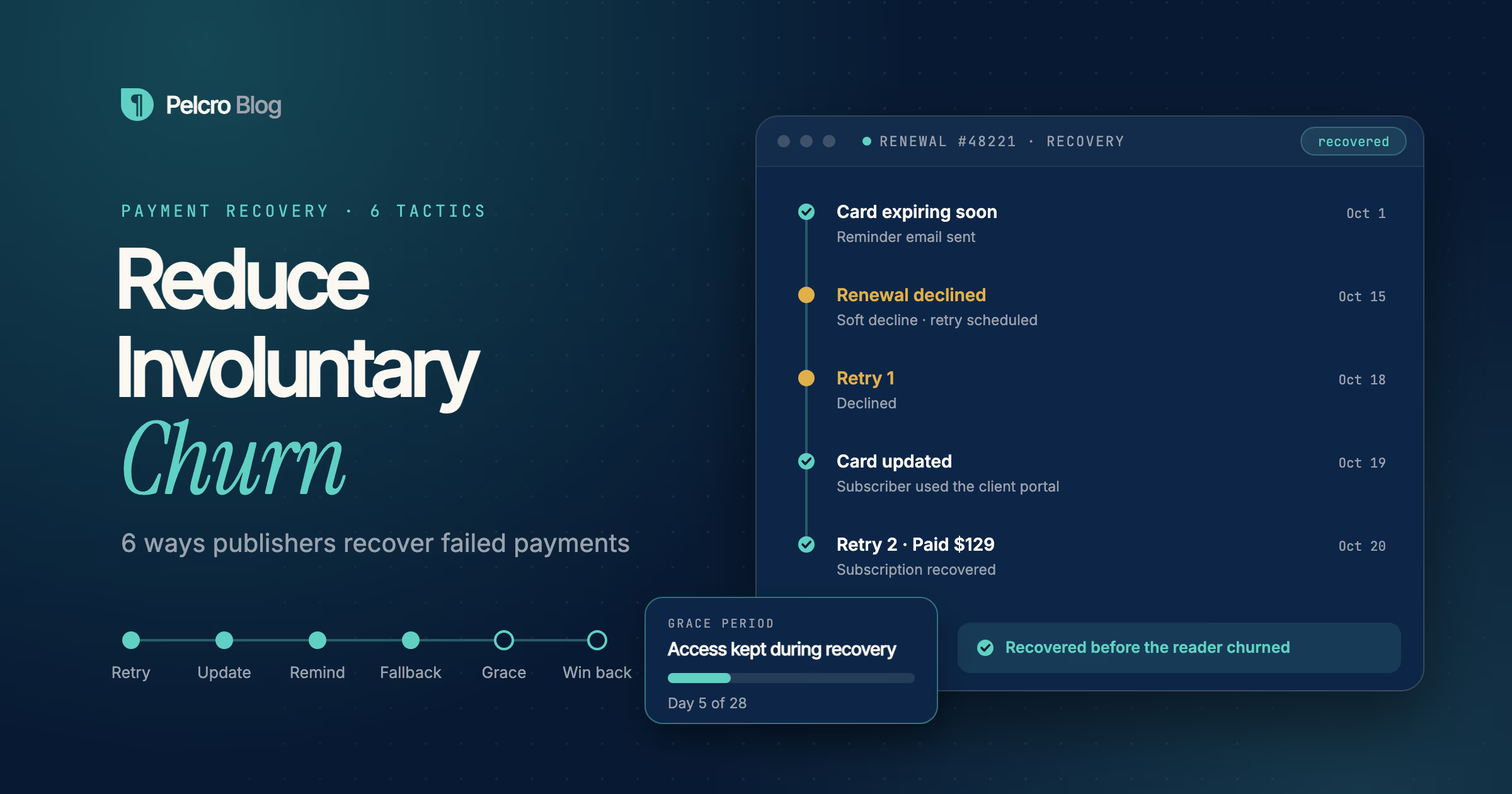
Publishers reduce failed payments and involuntary churn with six tactics: smart payment retries, automatic card updaters, pre-dunning emails before a card expires, a fallback payment method, a grace period that keeps access on while payment is recovered, and win-back flows for subscribers who lapse anyway. Used together, they recover subscribers who never meant to leave.
This guide is for subscription, audience and finance teams at newspapers and magazines who want to know which of these tactics matter most and what the published evidence says about each one. It covers how involuntary churn works, the six tactics in order, how to prioritize them, and how Pelcro handles each step.
This guide is published by Pelcro. Last updated: October 13, 2026.
What is involuntary churn for publishers?
Involuntary churn is the loss of a subscriber whose renewal payment failed, not one who chose to cancel. An expired card, a bank decline or an outdated billing address ends the subscription even though the reader still wanted it.
It is a large share of the problem. Piano's benchmark data for December 2024 puts passive churn at 32% of total churn across its news clients (vendor research). A commercial director at Finland's Alma Media estimated involuntary churn at 30% to 40% of all churn in an INMA column.
Many of these subscribers never notice the problem. When The Telegraph surveyed churned subscribers, more than half did not realise there was an issue with payment, as INMA reported in 2020. That is why involuntary churn is the most recoverable kind: the subscriber already wants the product.
Publishers have historically been less aggressive about it than other subscription businesses. An MPP Global analysis of 13 million subscribers for INMA found publishers set a maximum of 2.6 payment retries on average, against 13.2 for broadcasters. Retries saved 0.7% of publishing subscriptions in the period studied, against 4.5% for video streaming.
How do publishers reduce failed payments and involuntary churn?
The six tactics below run roughly in the order a failed renewal moves through them. Each one catches subscribers the previous step missed.
| Tactic | What it fixes | When it runs | Published evidence |
|---|---|---|---|
| Smart retries | Temporary declines (funds, bank limits, network errors) | After a renewal fails | Retries saved 0.7% of publishing vs 4.5% of streaming subscriptions (INMA, 2020) |
| Card updaters | Expired or reissued cards | Before and after renewal | Seattle Times: 30% fewer non-payment stops at rollout (Better News, 2021) |
| Pre-dunning emails | Cards that will expire before renewal | Weeks before renewal | Recommended by Gannett and Seattle Times; no independent effect size found |
| Payment method fallback | A single card that keeps failing | At checkout and on failure | Gazeta Wyborcza moved recurring-payment subscribers from 10% to 80% in a year (GNI) |
| Grace periods | Subscribers cut off before recovery finishes | During recovery | Telegraph: 4 to 28 days cut passive churn by 10 points (INMA, 2020) |
| Win-back flows | Subscribers who lapsed anyway | After the subscription ends | 50.2% of Piano win-backs were passive churners (Piano, 2024 data) |
1. Smart payment retries
A smart retry re-attempts a declined renewal on a schedule chosen for when the charge is most likely to clear. A decline for insufficient funds, for example, is worth retrying after a typical payday rather than an hour later.
The publisher gap here is large. In the MPP Global analysis for INMA, it took up to 16 attempts to get a successful renewal after the first one failed. Publishers that stop at two or three retries give up on subscribers who would have paid.
Retries only help with some payment types. The same analysis notes they matter for cards and PayPal, while direct debit is handled differently, so check your payment mix before you tune the schedule.
2. Automatic card updaters
A card account updater asks the card networks for a subscriber's new card number or expiry date when a bank reissues a card. The subscription keeps renewing without the reader doing anything.
The Seattle Times reported that card updaters, when first implemented, produced a 30% decrease in non-payment stops. A commercial director at Alma Media called automated card account updates probably one of the most efficient methods to prevent involuntary churn.
Card updaters are usually a feature of your payment processor rather than your subscription platform. Ask your processor whether it is switched on, and for which card networks.
3. Pre-dunning emails
A pre-dunning email warns a subscriber that their card will expire before the next renewal and links them straight to a page where they can update it. It prevents the failure instead of recovering from it.
Publishers recommend it, though nobody has published an independent effect size for publishers. Gannett's customer experience lead advised implementing pre-grace communications even earlier. The Seattle Times added expiration emails and on-site messages to logged-in readers whose card was expiring, as part of the program described in the next section.
On-site prompts reach readers who skip email. A 2021 American Press Institute retention survey found that about 33% of publishers communicate one to one on site with subscribers to update card details.
4. Payment method fallback
Payment method fallback means a subscription has somewhere else to go when one method fails. That can be a second saved card, a wallet such as PayPal or Apple Pay, or a bank payment like ACH or direct debit that does not expire.
Recurring payment methods make the biggest difference at signup. The Google News Initiative reported that Gazeta Wyborcza moved subscribers who provided recurring payments from 10% to 80% within a year after six months of checkout experiments.
Fallback also works on the processor side. If you run more than one payment gateway, routing a declined charge to a second gateway recovers payments that failed for gateway-specific reasons.
5. Grace periods
A grace period keeps a subscriber's access on while you retry the payment and ask them to update it. Cutting access on day one turns a fixable billing problem into a cancellation.
Short grace periods are common. An INMA Master Class poll found 44% of publishers set the grace period at 14 days or fewer. The Telegraph extended its grace period from four to 28 days and reduced passive churn by 10 percentage points from January to May.
The Seattle Times took a similar route. It extended its grace period to 27 days and saw an initial 21% decline in non-payment stops. Its unintentional churn reached 9.72% annually, the lowest in its digital subscription history.
6. Win-back flows
A win-back flow contacts subscribers after their subscription has ended and makes it easy to restart. For involuntary churners, the message is simple: your payment didn't go through, and here is a one-click way to fix it.
This audience is worth the effort. In Piano's December 2024 benchmark data, 50.2% of win-backs came from passive churners (vendor research).
How should a publisher prioritize these tactics?
Start by measuring. Split your churn into voluntary cancellations and payment failures, and track the involuntary churn rate on its own each month. The Shorenstein Center and Lenfest Institute recommend publishers determine sources of unintentional churn and adopt automatic card updating and grace periods with their subscription providers.
Then fix the cheapest gaps first. Card updaters and a longer grace period are mostly configuration changes, and both have published publisher results. Smart retries come next, because most publishers retry far less than other subscription businesses.
Pre-dunning emails, payment fallback and win-back flows take more work because they involve copy, checkout design and offers. They are worth it once the automatic steps are in place, since they catch the subscribers the automation can't reach.
Finally, review the numbers every quarter. The goal is a falling involuntary churn rate and a rising recovery rate on failed payments, not just more emails sent. Pair this with our guides to metered, premium and dynamic paywalls and to subscription management software for publishers if you are reviewing the whole funnel.
How does Pelcro reduce failed payments and involuntary churn?
Pelcro builds failed payment recovery into the same platform that runs subscriptions, billing and access, so most of the steps above work from one subscriber record. Pelcro's media billing software and payment processing cover the payment side.
Retries. When a payment gateway returns a soft decline, Pelcro retries the card on a schedule you set: every 3, 5 or 7 days, for up to five attempts. The failed payment retries setting is documented for developers. Five attempts is fewer than the 13 or more some analyses recommend, so publishers who want a longer schedule should pair Pelcro with their processor's own retry tools.
Pre-dunning and dunning emails. Pelcro's automated emails include a Card Expiring Soon reminder before a payment method expires and a Payment Failed notice during each retry. Subscribers update their card themselves in the client portal.
Grace periods. You choose what happens when retries run out: cancel the subscription immediately, or leave it active with the invoice open until an automatic uncollectible deadline you set. The second option works as a grace period.
Payment fallback. Subscribers can pay with cards, Apple Pay, Google Pay, PayPal, and ACH or BACS direct debit, and can store more than one payment method. Pelcro can route a charge by currency or region, or to a fallback gateway when one declines.
Cancellation and win-back offers. Pelcro's cancellation flows offer a pause, a downgrade or a save offer when a subscriber tries to leave. For anything more specific, Pelcro's AI coding agent builds custom offer pages from a prompt, such as a time-limited coupon for lapsed subscribers with a countdown, and ships them on a branch with a preview link.
When Pelcro isn't the right fit. If you want a long, decline-reason-aware retry schedule, a dedicated payment recovery tool goes further than Pelcro's five-attempt retries. If your only problem is failed card payments on an existing billing system you want to keep, a standalone recovery tool or your payment processor's own retry and updater features may be enough. Pelcro makes most sense when you also want subscriptions, paywall access and print fulfillment on one platform.
Frequently Asked Questions
What is the difference between voluntary and involuntary churn?
Voluntary churn is a subscriber choosing to cancel. Involuntary churn is a subscription that ends because a renewal payment failed, usually from an expired card or a bank decline. The fixes are different: voluntary churn needs better content and offers, while involuntary churn needs better payment recovery.
How much of a publisher's churn is involuntary?
Published estimates cluster around a third. Piano's December 2024 benchmark puts passive churn at 32% of total churn for its news clients, and an Alma Media executive estimated 30% to 40%. Your own share depends on your payment mix and how much recovery you already do.
How many times should a publisher retry a failed payment?
More than most do today. An MPP Global analysis for INMA found publishers allowed 2.6 retries on average against 13.2 for broadcasters, and some renewals took up to 16 attempts to succeed. Spread retries over your grace period rather than firing them all in the first days.
How long should a grace period be?
Long enough for retries and reminders to work. The Telegraph moved from four to 28 days and the Seattle Times to 27 days, and both reported fewer payment-related stops afterwards. An INMA poll found 44% of publishers use 14 days or fewer.
Does a card updater replace dunning emails?
No. A card updater fixes reissued and expired cards automatically, but it can't fix a closed account, a fraud block or a card the bank doesn't report. Dunning and pre-dunning emails reach the subscribers the updater misses, so most publishers run both.