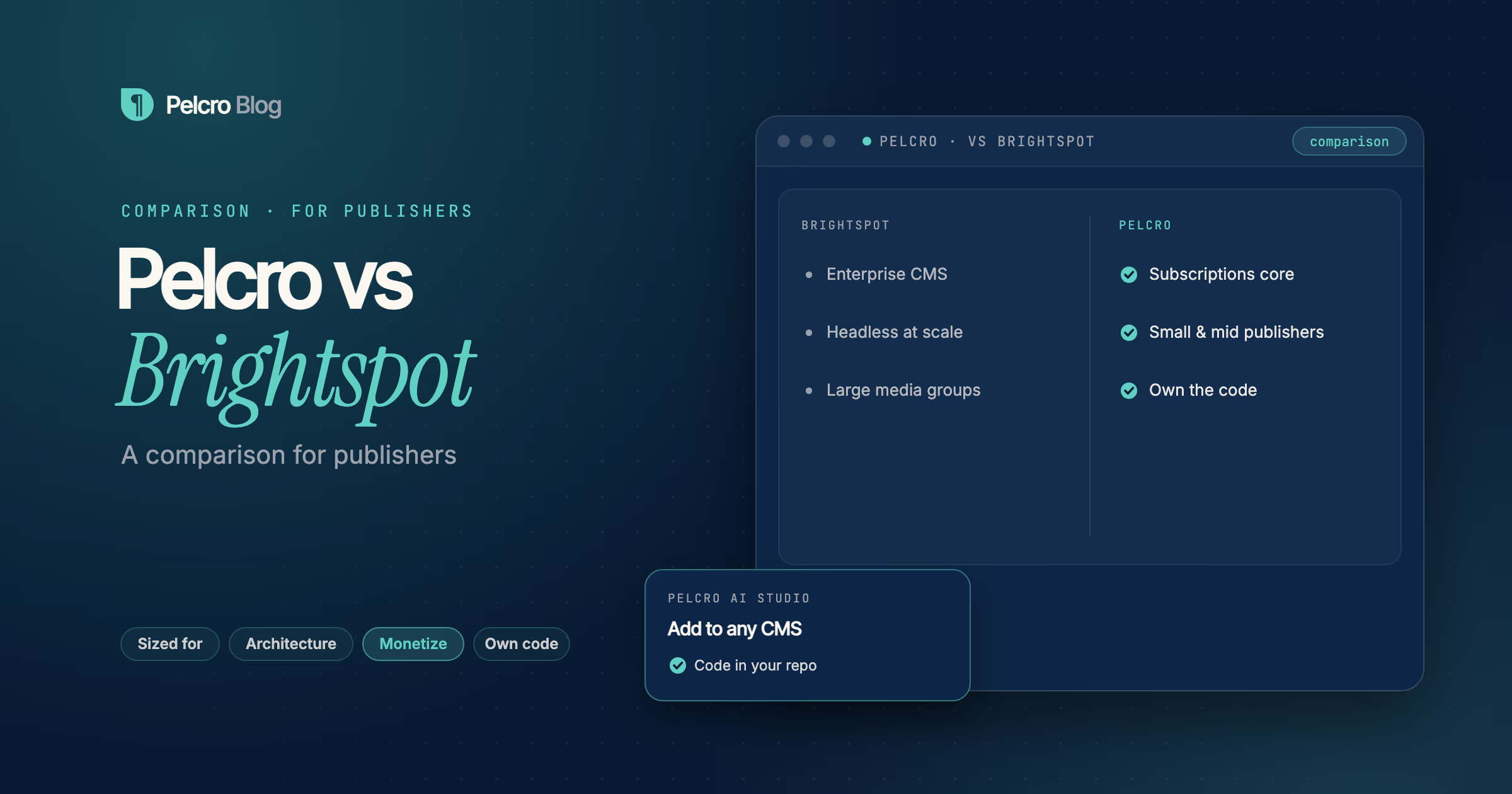
Pelcro and Brightspot CMS are built for different jobs: Brightspot is an enterprise content management system for large media companies, with headless delivery, structured content modeling, and editorial workflows, while Pelcro is a subscription and monetization platform whose AI Website Builder can scaffold a publishing site as code your team owns. If your priority is enterprise editorial production across many sites, that is Brightspot's territory; if it is subscriptions, billing, and owning your stack without enterprise cost, that is where Pelcro fits.
This comparison is for publishers weighing Brightspot against Pelcro. It covers what each one is, how they compare, where each fits, and how Pelcro can sit alongside a headless CMS rather than replace it.
What is Brightspot CMS?
Brightspot is an enterprise CMS aimed at large media and publishing organizations. It describes its platform as headless, decoupled, or a hybrid of the two from a single instance, with an API-first foundation, GraphQL APIs, and prebuilt editorial content types. The focus is structured content and governance at scale.
For media teams, Brightspot documents capabilities like Media Desk for digital asset management, customized editorial workflows, content syndication, and an optional Assignment Desk for planning and tracking stories. Named customers include the Los Angeles Times, U.S. News and World Report, POLITICO, NPR, and Univision, and its main public case study is Televisa, which replatformed nine sites onto Brightspot. It is a serious system for publishers running many titles with central editorial governance.
What is Pelcro?
Pelcro is a subscription and membership platform for publishers. Billing, paywalls, payment recovery, print fulfillment, and the subscriber record run on one platform, so a reader stays a single record across access and payments. Brightspot is organized around content and how it is modeled and delivered. Pelcro is organized around the subscriber and the revenue.
Pelcro also includes the AI Website Builder, which builds a publishing site from a plain-language prompt. It scaffolds article templates and a newsletter as ordinary code in your repository, wired to Pelcro from the first commit, the same build the subscription website builder walks through, and AI Studio, Pelcro's agent for paywalls and checkouts, adds the metered paywall. The code is yours to read, edit, and host, with no proprietary runtime. For publishers who already run a CMS, AI Studio can instead mount the paywall into the existing article template.
How do Pelcro and Brightspot compare?
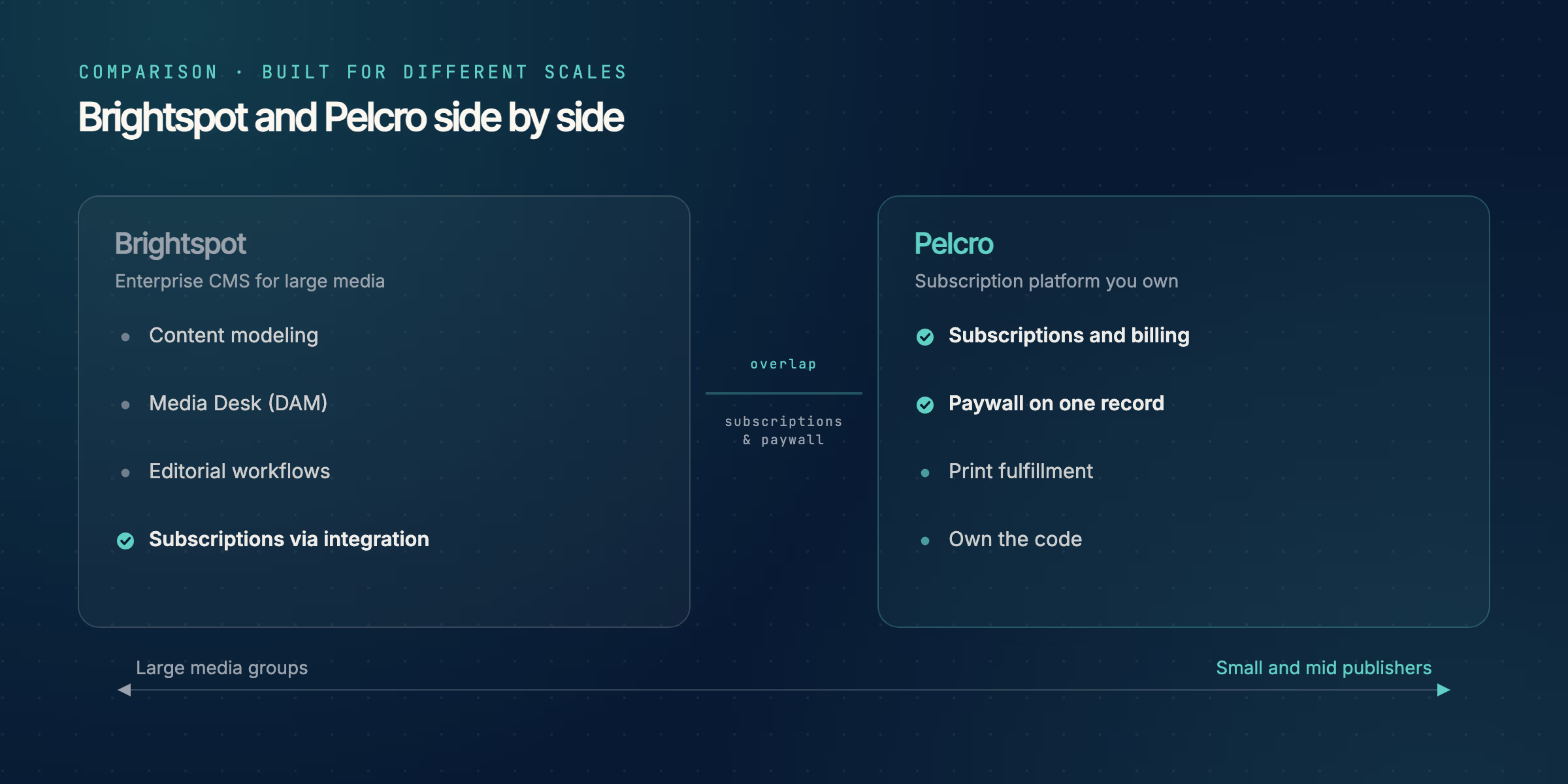
The platforms differ in what they are built around, who they are sized for, and what you own.
| Consideration | Brightspot CMS | Pelcro |
|---|---|---|
| Built around | Enterprise content modeling and delivery | Subscriptions, billing and the subscriber record |
| Sized for | Large media companies and multi-site groups | Small and mid-size publishers |
| Architecture | Headless, decoupled or hybrid CMS | Monetization layer plus an AI site builder |
| Monetization | Through integrations with a subscription system | Native paywalls, billing and print fulfillment |
| What you own | Content in a hosted enterprise platform | Ordinary code committed to your repo |
A third-party review frames Brightspot as well suited to centralized governance across sites, and notes it is a poor match for teams that need immediate setup, low pricing, or a simple publishing interface. That is a fit judgment, not a flaw: Brightspot is engineered for scale. Pelcro is not an enterprise editorial CMS and does not try to be. The two overlap only on monetization, and even there they approach it differently.
When does each one fit?
Brightspot fits a large publisher or media group that needs structured content, digital asset management, editorial workflows, and headless delivery across many properties, with the budget and team to run an enterprise platform.
Pelcro fits a small or mid-size publisher whose priority is subscriptions and reader revenue, who wants native paywalls and print fulfillment on one record, and who wants to own their site as code rather than operate inside a hosted enterprise system. It is also a fit for a publisher who wants a site scaffolded quickly without a large dev team.
Can you use Pelcro with Brightspot or a headless CMS?
Yes. Because a headless CMS separates the content backend from the front end readers see, the paywall and subscription logic live in that front end, which is exactly where Pelcro operates. the AI Website Builder can build that front end, or AI Studio can modify an existing one to mount the gate and wire subscriptions to Pelcro, while Brightspot or another headless system keeps serving the content.
This means the choice is not always Pelcro instead of a CMS. A publisher can keep a content platform they are happy with and use Pelcro for the monetization layer, or, for a smaller operation, use the AI Website Builder to build the whole site. For a broader view, read subscription management software for publishers.
Watch Pelcro AI Studio write the change
Frequently Asked Questions
What is Brightspot CMS?
Brightspot is an enterprise content management system for large media and publishing companies. It offers headless, decoupled, or hybrid delivery from one instance, structured content modeling, digital asset management, and editorial workflow tools.
Is Brightspot a headless CMS?
Brightspot supports headless delivery, and also decoupled and hybrid models from a single CMS instance. It provides an API-first foundation with GraphQL APIs and prebuilt content types.
Who uses Brightspot?
Brightspot lists media customers including the Los Angeles Times, U.S. News and World Report, POLITICO, NPR, and Univision. Its main public case study describes Televisa replatforming nine sites onto Brightspot.
How much does Brightspot cost?
Brightspot does not publish pricing; it is quoted on request as an enterprise contract. Reviews note that pricing is opaque and migrations tend to be services-heavy, which matters for smaller budgets.
What is an alternative to Brightspot?
Alternatives include other enterprise and headless CMS platforms, and lighter setups for smaller publishers. Teams focused on subscriptions and monetization rather than enterprise content modeling often look at a dedicated platform like Pelcro.
Is Brightspot good for small publishers?
Brightspot is built for large media organizations, and third-party reviews flag it as a poor match for teams needing immediate setup, low pricing, or a simple interface. Smaller publishers often find a lighter CMS plus a monetization layer a better fit.
Can Pelcro work with a headless CMS like Brightspot?
Yes. A headless CMS serves content to a separate front end, and Pelcro's paywall and subscription logic live in that front end. AI Studio can wire the gate and billing there while the headless CMS continues to manage content.
Does Pelcro replace Brightspot?
Not as an editorial CMS. Pelcro replaces or strengthens the subscription and paywall layer, and with the AI Website Builder it can build a site for a smaller publisher, but it is not an enterprise content platform with DAM and multi-site governance.
What is the difference between a headless CMS and Pelcro?
A headless CMS manages and delivers content through APIs. Pelcro manages subscriptions, billing, and paywalls, and can build or modify the front end that presents the content. They address different layers of the stack and can run together.