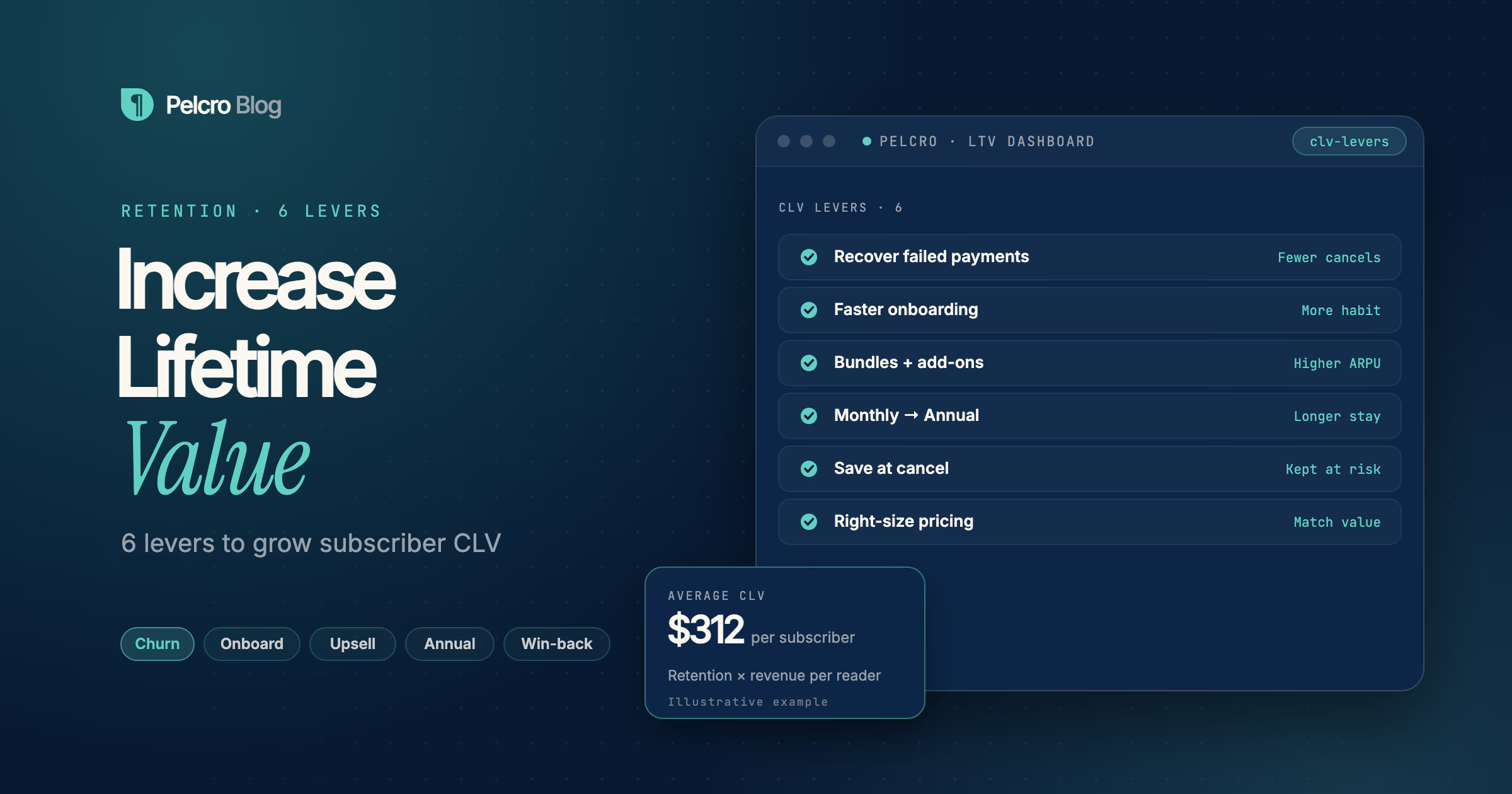
To increase customer lifetime value, keep subscribers longer and grow the revenue each one brings in: cut involuntary churn, onboard new readers faster, upsell bundles, move monthly subscribers to annual, save cancellations with an offer, and set each plan's price to the value it delivers. CLV rises when you pull these levers together, because lifetime value is retention multiplied by revenue per subscriber.
This guide is for publisher subscription and retention teams that want to increase customer lifetime value without just raising prices. It covers six levers, why each one moves CLV, and how to act on them.
What is customer lifetime value (CLV)?
Customer lifetime value, or CLV, is the total revenue you expect from a subscriber across their whole relationship with you. A reader paying $12 a month who stays 20 months has a CLV of $240, before costs.
For a publisher, CLV is the number that justifies acquisition spend. If you know a subscriber is worth $240 over their lifetime, you know how much you can afford to spend to win one and still profit. It also reframes retention as revenue work, not just a support metric.
CLV has two inputs you can move: how long a subscriber stays, and how much they pay while they stay. Every lever below pushes on one or both. For the exact formula and how to calculate it, see our guide to customer lifetime value.
How to increase customer lifetime value: 6 levers
Work these in order of effort to impact. The first two protect the value you already have before you try to grow it.
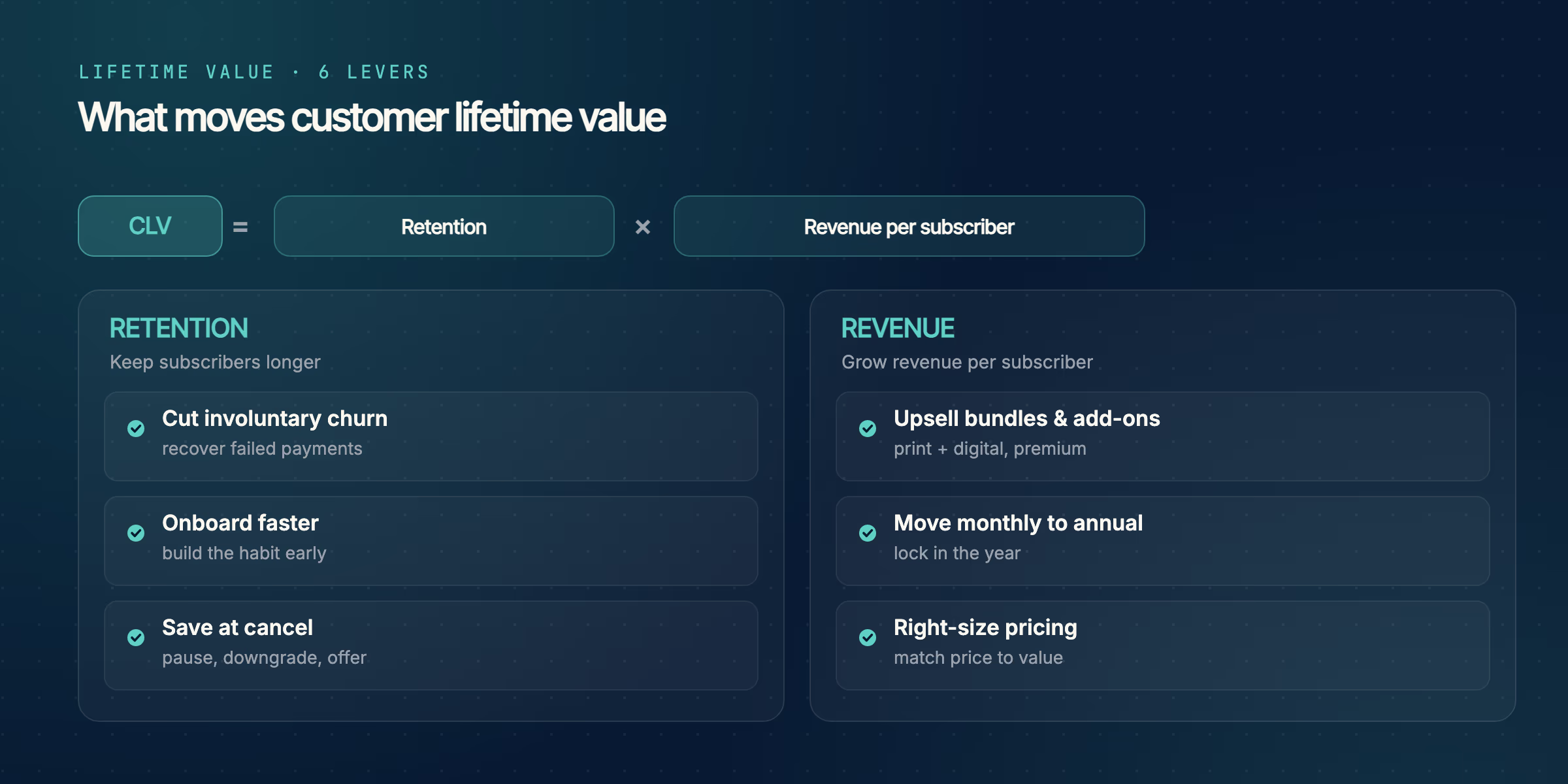
1. Cut involuntary churn. Expired and declined cards cancel subscribers who never meant to leave, which is pure lost CLV. Recover them with retries, dunning emails, and card-update prompts, and size the leak with the churn rate calculator. See reducing failed payments for the full process.
2. Onboard new subscribers faster. The first weeks decide whether a reader forms a habit. Guide them to the content and features that match why they subscribed, because an engaged subscriber renews and a forgotten one churns.
3. Upsell bundles and add-ons. Raise revenue per subscriber by offering print plus digital, premium tiers, events, or gift subscriptions. A reader already paying is the easiest person to sell more value to.
4. Move monthly subscribers to annual. An annual plan locks in a full year and usually retains better than monthly. Offer the switch at the right moment, such as the first renewal, as covered in our guide to monthly vs annual subscriptions.
5. Save cancellations with an offer. Not every cancel is final. A pause, a downgrade, or a targeted discount at the cancel screen keeps some subscribers who would otherwise leave, protecting the remaining CLV.
6. Price each plan to the value it delivers. Match price to how much a segment uses and values the product, and revisit pricing as your content and audience change rather than setting it once and forgetting it.
How Pelcro helps increase customer lifetime value
Pelcro works on both inputs of CLV from one platform. For retention, it runs failed renewals through payment recovery with retries and card-update prompts, and it supports pause, downgrade, and save offers at cancellation, so fewer subscribers leave by accident or on impulse.
To grow revenue per subscriber, Pelcro lets you sell print and digital bundles, premium tiers, gifts, and add-ons on the same subscriber record, and it prorates plan changes automatically when a reader upgrades or moves to annual. Because billing, access, and the subscriber record are one system, an upsell or a plan switch updates access and invoicing together.
Pelcro also surfaces the data behind CLV, so you can see which plans, cohorts, and offers retain best and act on them. Published pricing is on the pricing page, and the wider toolset is compared in subscription management software for publishers.
Frequently Asked Questions
What is the fastest way to increase customer lifetime value?
Cutting involuntary churn is usually the fastest, because recovering failed payments keeps subscribers you already won without any new acquisition. It protects CLV you would otherwise lose silently to expired cards.
Does increasing CLV mean raising prices?
No. Price is only one lever, and often not the first. You can increase customer lifetime value by retaining subscribers longer and selling more value through bundles and add-ons, which grows CLV without a straight price rise.
How is CLV different from ARPU?
ARPU measures revenue per user in a period, while CLV measures total revenue across the whole relationship. CLV combines ARPU with how long subscribers stay, so retention changes CLV even when ARPU is flat.
How do bundles increase customer lifetime value?
Bundles raise revenue per subscriber and often improve retention, because a reader using print and digital together has more reasons to stay. Both effects push CLV up at once.