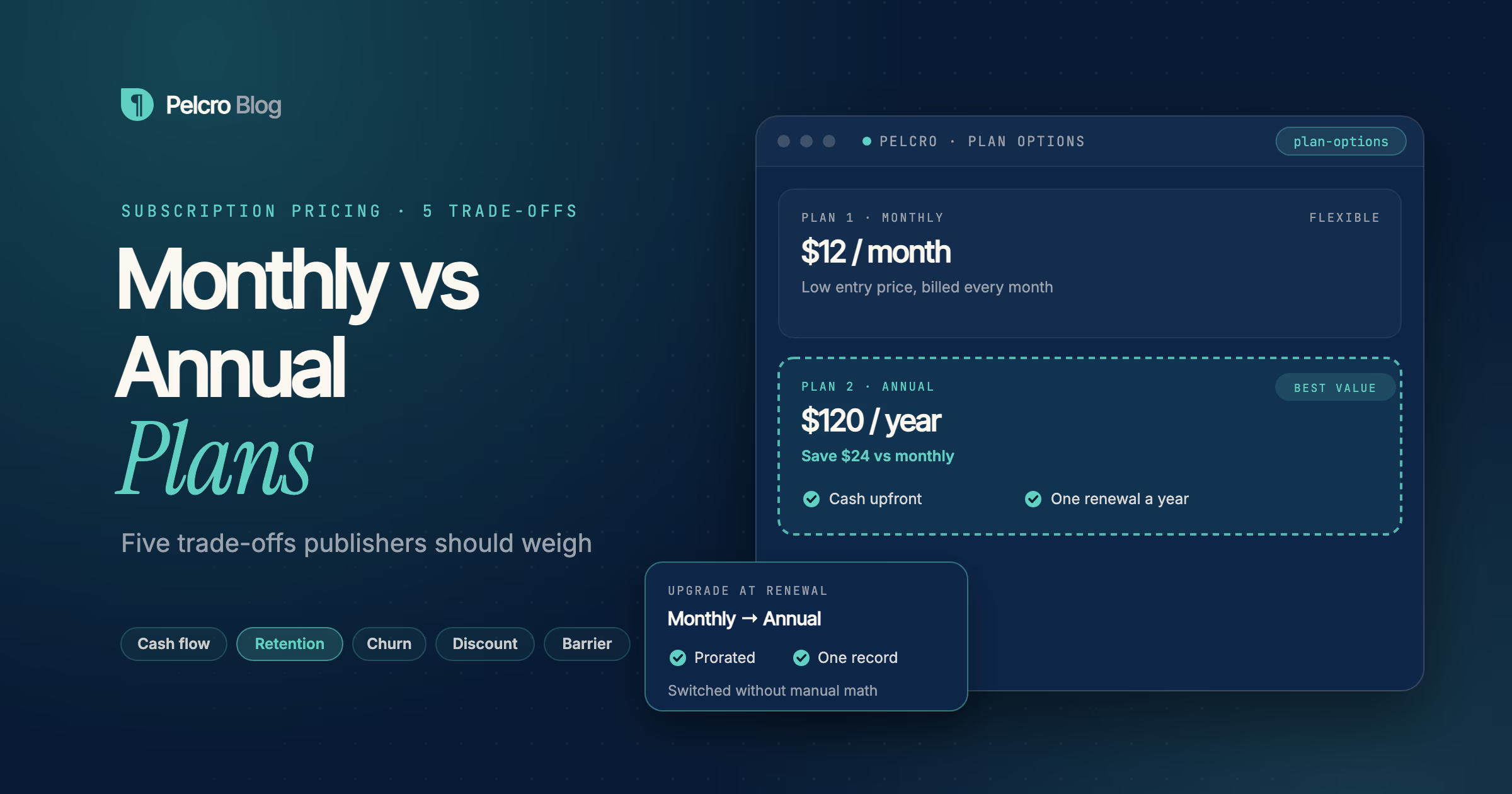
The monthly vs annual subscription decision comes down to one move: offer both. An annual subscription gives a publisher cash upfront and stronger retention, a monthly subscription lowers the barrier to the first sale, and most publishers sell both while steering readers toward annual at signup and at renewal.
This guide is for publisher subscription and revenue teams deciding how to price their plans. It walks through five trade-offs between monthly and annual subscriptions, including cash flow, retention, churn timing, discount math, and reader commitment.
What is an annual subscription?
An annual subscription bills a reader once for a full year of access, usually at a discount to twelve monthly payments. A magazine might charge $120 a year or $12 a month, so the annual plan saves the reader $24 and locks in the publisher's revenue for the year.
For a publisher, an annual subscription is cash in the bank and a full year before the next cancel decision. A monthly subscription trades that security for reach, because a $12 first charge converts more first-time readers than $120 does.
Most subscription platforms can bill both cycles, but they differ in what happens around them. Whether a reader can switch plans with a fair proration, whether annual renewals run through payment recovery, and whether the paywall can show the right cycle to the right reader all decide how much of the upside you actually capture.
Monthly vs annual subscriptions: the 5 trade-offs
There is no single right answer, so weigh these five trade-offs against your own audience and content.
| Trade-off | Monthly | Annual |
|---|---|---|
| Cash flow | Paid in small monthly amounts | Full year collected upfront |
| Retention | A cancel decision every month | One cancel decision a year |
| Churn timing | Churn spread across the year | Churn concentrated at renewal |
| Discount math | Full price, higher per-reader revenue if they stay | Discount traded for commitment and cash |
| Entry barrier | Low first charge, more first sales | Higher first charge, fewer first sales |
The case for annual is cash and commitment. You collect a full year on day one, and an annual subscriber makes one renewal decision instead of twelve, which is why annual plans usually retain better. The trade-off is timing, because annual churn concentrates in a spike at renewal instead of spreading quietly across the year, so that one date needs a strong renewal reminder and a solid payment-recovery process.
The case for monthly is reach. A low first charge converts more first-time readers than a full year does, and you keep the full monthly price from anyone who would have stayed anyway. The annual discount only pays off on readers who would otherwise have churned early, so the common play is to acquire on monthly, prove the value, and move readers to annual at the first renewal.
Set your own numbers to see how the two plans compare.
- Collected upfront
- $12
- Cancel decisions / year
- 12
- Billed as
- 12 charges
- Collected upfront
- $120
- Cancel decisions / year
- 1
- Works out to
- $10.00/mo
How Pelcro helps you run monthly and annual plans
Pelcro lets you sell monthly and annual subscriptions for the same product and set the discount on each cycle, so a reader can pick the plan that fits and you keep one subscriber record either way.
When a reader moves between plans, Pelcro prorates the change automatically, so an upgrade from monthly to annual is billed fairly without manual math. You can estimate how a mid-cycle change is calculated with the proration calculator.
Because annual renewals land as one large charge, a failed card at renewal is a bigger risk than on a monthly plan. Pelcro runs renewals through payment recovery with retries and card-update prompts, and you can size that exposure with the churn rate calculator. For the wider tooling that sits around plans, see our guides to subscription management software for publishers and monthly recurring revenue.
Frequently Asked Questions
Should publishers offer monthly or annual subscriptions?
Most publishers should offer both. Monthly plans win more first-time subscribers with a low entry price, and annual plans improve cash flow and retention. A common approach is to acquire readers on monthly and move them to annual at the first renewal.
Is an annual subscription always cheaper for the reader?
Usually, but not always. Publishers typically discount the annual subscription against twelve monthly payments to reward the commitment, though the size of that discount is a pricing choice, not a rule. Compare the yearly total of each plan before deciding.
How big should the annual discount be?
There is no fixed number, so treat it as a lever rather than a standard. A larger discount lifts annual take-up but lowers revenue per reader, so test a modest discount first and measure annual adoption and retention before increasing it. See our guide to ARR for how the choice flows through to recurring revenue.
Do annual subscriptions reduce churn?
They usually reduce how often churn can happen, because an annual subscriber makes one renewal decision a year instead of twelve. The risk is that annual churn concentrates at renewal, so a strong renewal reminder and payment recovery process matter more on annual plans.