
A high-converting subscriber journey moves a visitor through four steps: a short free sample, a registration wall that turns them into a known reader, a personalized habit-building phase, and a paywall offer timed to their engagement. The New York Times, Financial Times, Wall Street Journal and Substack each run a version of this flow, with different choices about when to ask for an email and when to ask for money.
Reader loyalty can't be left to chance. We looked at how these four publishers approach the journey and mapped a ready-to-deploy onboarding flow that smaller publishers can adapt without reinventing the wheel.
How NYT, WSJ, FT and Substack Build the Subscriber Journey
Entry points are shifting towards early commitment

Leading publishers are recalibrating the very first interaction. The New York Times asks for registration after a single free article; the Financial Times and Wall Street Journal draw a hard line from the first click; Substack lets readers roam but keeps the pressure on with steady signup nudges. This pattern isn't about who's "stricter," it's about intent: push for early commitment without blowing up trust.
For most publishers, a lightweight meter (2 to 3 free reads) paired with a visible progress indicator strikes the balance. The prompt that performs best doesn't slam the door; it arrives mid-scroll on the last free piece and frames registration as a natural next step ("Two free reads left this week! Create a free account to keep going"). It feels like continuity, not a blockade, and it hands a warmer audience to your paywall logic later.
Personalization is emerging as the stickiness factor
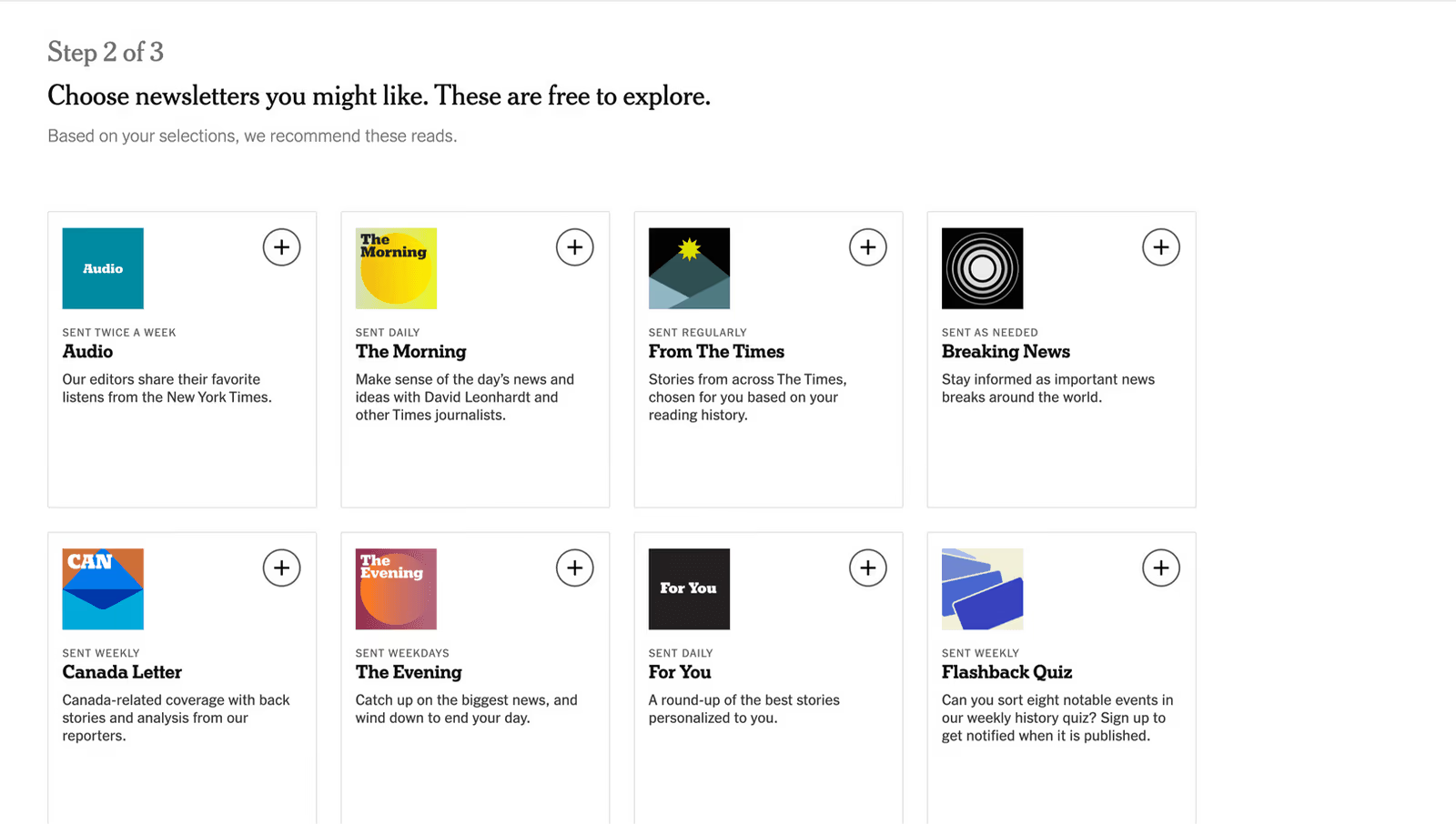
Once readers register, the winners make the product feel "theirs" immediately. NYT invites topic selection and adapts the experience; Substack guides users toward interest categories and creators; FT and WSJ generally keep personalization modest before the paywall. The common thread: small choices at onboarding lead to longer first sessions and more return visits.
This doesn't require heavy AI or a full recommendation engine. A simple interest picker (3 to 5 categories) at signup is often enough to pre-fill a homepage module and seed a tailored welcome email ("Here's your lineup for the week").
Consistency matters more than complexity: save preferences to the profile, reflect them in newsletters and feeds, and reinforce them with gentle prompts over the first week. Readers recognize themselves in the product and come back because it feels built for them.
Practical note: Use your CMS's native tagging and a basic form (Typeform, Outgrow or built-in fields) to capture interests. Pipe selections to email and homepage modules so the personalization shows up everywhere, not just once.
Engagement hooks are redefining "value"
Content alone no longer secures loyalty. NYT supplements with games, newsletters and interactive features. Substack leans on creator chats and community interaction, while FT and WSJ mostly rely on content value.
Adding even a single interactive feature (a weekly quiz, poll, or digest email) gives readers a reason to come back on a schedule. Engagement isn't decoration; it's the mechanism that makes readers return tomorrow.
Games are becoming a subscriber acquisition channel in their own right
NYT isn't treating Games as a side project anymore: it added 110,000 net new digital subscribers from Games in Q1 2025 alone, compared with 81,000 from News. FT and WSJ have no comparable play, and Substack's answer to habit-building is community, not games.
You don't need NYT's product budget to test this. Pelcro's free Word Scramble game comes with an embed code you can drop straight into your own site, so you can start using a daily game as an onboarding and retention hook without a build cycle.
Paywall design is being used to reduce perceived risk
NYT's metered paywall coupled with discounted trials stands in contrast to FT and WSJ's hard lines. Substack offers free and paid tiers, with community perks as a differentiator.
The common thread: warm leads convert better when they aren't shut out too early. Trial windows of 7 to 14 days, paired with clear benefit messaging and urgency cues, give readers time to build a habit before they pay. Progress bars during trials are also increasingly common as subtle nudges to commit before access lapses.
Community is the differentiator in turning subscriptions into memberships
Substack has shown that direct creator interaction drives loyalty. NYT maintains active comment sections, while FT and WSJ still largely treat readers as passive consumers.
For others, this is an untapped lever. Even a monthly members-only Q&A or a subscriber voting mechanism can deepen the emotional bond and give readers a reason to renew.
Iteration is becoming the quiet driver of growth
The publishers that win aren't running a single "perfect" onboarding flow: they treat it as a living system. The New York Times keeps adjusting registration prompts, trial offers and email sequences, not because they were broken, but because small gains stack over time.
Funnel metrics (visit, registration, first session length, return visit, subscription) make drop-offs visible. A long form might be trimmed, a call-to-action re-positioned, or an email cadence shifted by a day. Each change is minor; together they compound.
Heatmaps, A/B experiments and analytics dashboards are the feedback loop that keeps the flow evolving. Without them, onboarding stalls.
Registration Wall for Publishers: Where It Fits in the Journey
A registration wall for publishers is a gate that asks a reader to create a free account, usually with an email address, before they can keep reading. It sits between open access and a paywall, and its job is to turn anonymous traffic into known readers you can email, personalize for, and later convert.
In the journeys above, the registration wall is the hinge. NYT uses it after a short free sample, Substack uses constant signup prompts in place of a hard wall, and FT and WSJ skip straight to a paywall for most content.
Registration wall vs. metered paywall vs. hard paywall
| Registration wall | Metered paywall | Hard paywall | |
|---|---|---|---|
| What the reader gives | Email address (free account) | Payment after a set number of free reads | Payment before any premium read |
| Main goal | Identify readers and grow first-party data | Balance reach with conversion | Maximize revenue per reader |
| Reach and search traffic | High | Medium to high | Lower |
| Best for | Building an email list and a warm audience for offers | General news and broad-interest titles | Specialist content readers already value |
| Used in this journey by | NYT (after a short sample), Substack (signup prompts) | NYT | FT, WSJ |
Most publishers do not pick one. A common stack is a free sample, then a registration wall, then a meter for registered readers, then a paid offer.
5 registration wall practices drawn from these publishers
-
Ask after value, not before it. Trigger the wall on the last free read, so the reader already knows what they are signing up for.
-
Keep the form to one field. Ask for an email address first and collect interests on the next screen, where they feel like personalization rather than a toll.
-
Show the meter. A visible "free reads left" counter makes the wall a predictable step instead of a surprise.
-
Pay off the registration immediately. A tailored welcome email and a personalized homepage module prove the account was worth creating.
-
Recognize readers on every device. If a registered reader is asked to register again on their phone, the wall becomes friction instead of a relationship.
Registration wall metrics to track
Measure registration rate, segmented by traffic source, because direct visitors, search visitors and social visitors behave very differently. Then track how many new registrants return within the first week, how many open the welcome email, and how many convert to paid within 30 and 90 days.
For a deeper walkthrough of setup and data collection, see our guide to how publishers use registration walls to grow subscribers.
The 10-Point Subscriber Journey Emerging as Standard
Across the industry, the most successful onboarding journeys increasingly share these features:
-
Visitor sees a free-article meter (2 to 3 reads at most).
-
A clear counter shows "free reads left."
-
A registration prompt triggers after the limit.
-
The new user selects 3 to 5 interest categories.
-
A personalized homepage or newsletter is generated instantly.
-
A welcome email reinforces the tailored picks.
-
A weekly quiz, poll or similar feature establishes the habit.
-
A newsletter drip builds routine.
-
The metered paywall triggers and a free trial is offered.
-
The subscriber gains access to community features.
How Pelcro Supports the Subscriber Journey
Pelcro's paywall supports metered, freemium and hard models, so you can let readers sample content, ask for a free account after a set number of reads, and then present a paid offer when engagement is strongest. Registered readers become subscriber records you can segment and reach with lifecycle campaigns.
Checkout, trials, renewals and failed payment recovery run on the same platform, so the reader who registered last week and the subscriber who renews next year share one record. That makes it possible to measure the whole journey, from first visit to renewal, instead of stitching it together from separate tools.
Looking for a dynamic paywall to put these lessons into practice? Talk to our team and we'll walk through your current funnel.
Frequently Asked Questions
What is a registration wall for publishers?
A registration wall asks a reader to create a free account, usually with an email address, before they can keep reading. Publishers use it to turn anonymous visitors into known readers they can email, personalize for, and convert to paid subscriptions later.
Is a registration wall better than a paywall?
They do different jobs. A registration wall builds an identified audience and keeps reach high, while a paywall earns revenue directly. Many publishers, including The New York Times, use a short free sample and a registration step before the paid offer.
How many free articles should readers get before a registration wall?
There is no universal number, and the right meter depends on your traffic mix and content. A lightweight meter of 2 to 3 free reads with a visible counter is a sensible starting point to test against. Measure registration rate and paid conversion, then adjust.
What should a publisher do right after a reader registers?
Make the account feel useful within the first session. Ask for 3 to 5 topic interests, send a tailored welcome email, and show a personalized module on the homepage. Then build a weekly habit with a newsletter, quiz or game before presenting a trial offer.