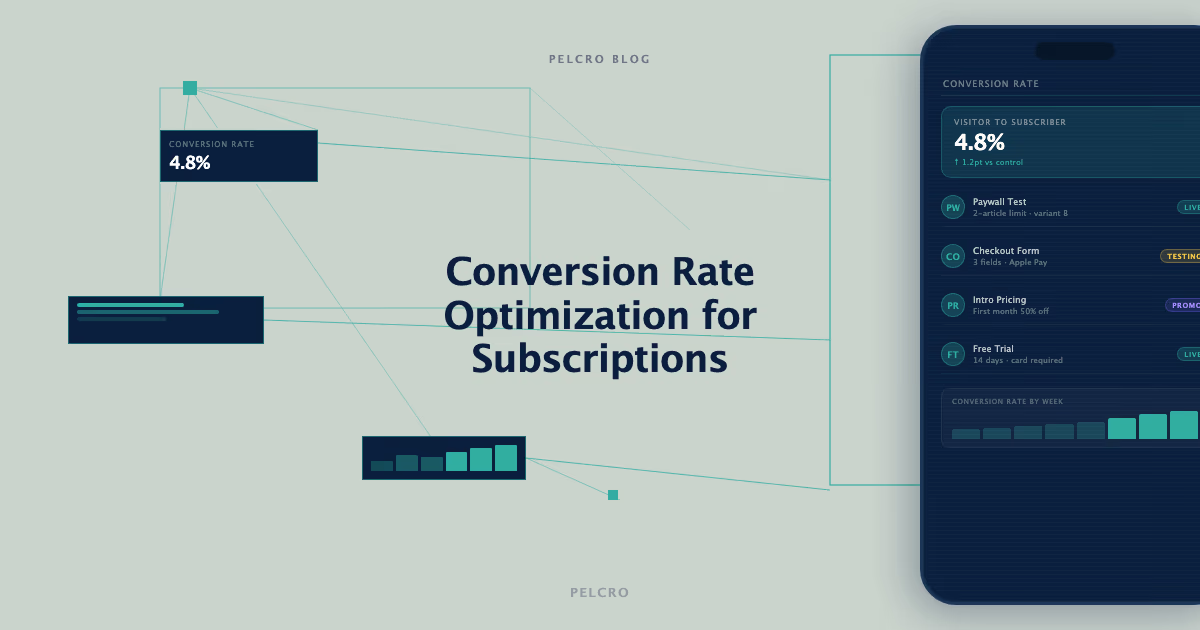
For subscription and membership businesses running on tight acquisition budgets, conversion rate optimization decides whether that spend turns into paying customers or gets spent on visitors who leave without converting.
This guide breaks down what conversion rate optimization means for a subscription business, the concrete tests that move a conversion rate up, and how Pelcro's platform supports that work end to end.
The short answer: the businesses that win at conversion rate optimization test one variable at a time, starting with the paywall, the checkout form, and the price itself.
What Is Conversion Rate Optimization for Subscription Businesses
Conversion rate optimization, or CRO, is the practice of systematically testing and improving the pages a visitor moves through before becoming a paying subscriber or member. A publisher running conversion rate optimization on its paywall might test a two-article free limit against three articles, to see which one converts more readers without giving away so much content that no one feels the need to pay.
For a subscription business, conversion rate optimization is not a single project with an end date. It is an ongoing cycle: find where visitors drop off, form a hypothesis about why, test a change against the current version, and keep whichever one performs better. A publisher or association that treats conversion rate optimization as a marketing afterthought leaves revenue on the table every month a low-converting page stays unchanged.
Most subscription platforms treat conversion rate optimization as something a separate analytics or testing tool handles, disconnected from the paywall and billing system that decides what a visitor actually sees. That gap makes it hard to know whether a conversion lift came from paying, retained subscribers or from short-term signups that churned before the first renewal. Pelcro keeps conversion rate optimization tied to the same platform that manages paywalls, checkout, and billing, so a test result reflects real subscriber revenue.
How to Improve Conversion Rate Optimization for a Subscription Business
The paywall or membership gate is usually the highest-leverage place to start conversion rate optimization, because it is the first moment a visitor decides whether the content is worth paying for. Testing the free-article limit, the paywall message, and where it appears in an article all move conversion rate directly, and small changes here compound across every visitor the site gets.
The checkout form is the second-highest leverage point. Every extra field on a signup or dues form, a required phone number, a mandatory account step before payment, gives a visitor one more reason to abandon. Cutting a checkout from six fields to three routinely lifts conversion rate more than a redesigned landing page does.
Pricing and promotion structure move conversion rate as much as page design does. A discounted first term, a lower entry-level tier, or a free trial gives a hesitant visitor a lower-risk way to convert, and testing the length of that offer against a control price is one of the fastest ways to find a lift that holds up at renewal.
None of these changes work without a disciplined process. Change one variable at a time, run each test long enough to reach a meaningful sample size, and measure conversion rate against paying, retained subscribers rather than free signups. Otherwise a test that lifts short-term conversions but hurts renewal rate gets mistaken for a win.
How Pelcro Solves This
Pelcro's paywall conversion tools let a publisher configure and test metered, soft, and hard paywall setups directly in the platform, so a team can compare free-article limits and messaging against real subscriber conversion rather than a third-party tool that never sees whether a visitor paid.
For checkout, Pelcro supports Apple Pay and Google Pay alongside a streamlined card flow, cutting the fields and steps between a visitor deciding to subscribe and completing payment, one of the most consistent conversion rate optimization wins available.
Pelcro's promotions tools let a team launch and test a discounted first term, a limited-time rate, or a targeted offer without engineering a one-off checkout page, so pricing experiments that move conversion rate ship in days instead of sprints.
Once a test is live, Pelcro's conversions tools tie paywall impressions, checkout starts, and completed payments into one funnel view, integrating with your CDP and email service provider, so conversion rate optimization gets measured against paying, retained subscribers instead of page views alone.
Frequently Asked Questions
What is conversion rate optimization for a subscription business?
Conversion rate optimization for a subscription business is the practice of testing and improving the paywall, checkout, and pricing pages a visitor moves through before becoming a paying subscriber or member. It measures success by conversion rate, the share of visitors who complete a purchase, not by page views or traffic alone.
What is a good conversion rate for subscriptions?
Conversion rate benchmarks vary widely by content type, price point, and traffic source, so there is no single number every subscription business should target. The more useful goal is a rising trend from a documented baseline, driven by a steady cadence of tests rather than a one-time redesign.
Where should a subscription business start with conversion rate optimization?
Start with the paywall or membership gate and the checkout form, since every converting visitor has to pass through both. A free-article limit that is too generous or too strict, and a checkout with more fields than necessary, both cap conversion rate no matter how much traffic marketing drives to the top of the funnel.
Can Pelcro help measure conversion rate optimization results?
Yes. Pelcro ties paywall impressions, checkout starts, and completed payments into a single subscriber record, so a team can see conversion rate at each funnel stage and confirm whether a test improved paying, retained subscribers rather than just short-term signups.