For a business owner being pitched AI bookkeeping by four vendors at once, the useful question is not whether it works but which parts of the job it does well and which parts it still fumbles. This post walks through what AI bookkeeping automates, shows a real extraction from our own tool including the field it got wrong, and gives you the questions to ask any provider before you sign.
The short answer: AI handles the volume reliably and the judgment unreliably, which is why a qualified human still signs off.
What Is AI Bookkeeping
AI bookkeeping is the use of machine learning models to do the recording layer of accounting: reading receipts and invoices, pulling structured fields out of them, categorizing transactions against a chart of accounts, and matching payments to the documents that justify them. It replaces the data entry, not the accountability.
The reason it works at all is that most bookkeeping is pattern recognition on semi-structured documents. A receipt has a merchant, a date, some line items, a tax breakdown and a total, arranged differently by every point-of-sale system on earth. Older optical character recognition turned that into loose text and then guessed which number was the total, which is why it broke on crumpled paper and unusual layouts. A vision model reads the document as a document and returns the fields directly.
The same shift applies to bank feeds and invoices. Categorizing a few hundred transactions a month against your accounts is repetitive comparison work, and reconciling an account is matching two lists and explaining the difference. Both are now largely automatable, and that automation is most of the cost saving in every AI bookkeeping pitch you will hear.
What has not changed is who is responsible when the books are wrong. A model produces a suggestion with a confidence score. It does not have a licence, it cannot be held to a professional standard, and it will be confidently wrong in ways that look exactly like being confidently right.
What AI Bookkeeping Automates, and Where It Fails
Reading receipts, bank feeds and invoices
This is the strongest use case. Extraction from documents is now accurate enough to trust as a first pass, with deterministic checks catching the rest. The important detail is that the checks are arithmetic, not AI: subtotal plus taxes plus tip has to equal the total, dates have to be plausible, and duplicate merchant-date-total combinations get flagged.
A real extraction
Here is an actual run. We put this sample receipt through the same public receipt scanner that runs inside our bookkeeping service, on 9 September 2026, and the output below is exactly what came back.
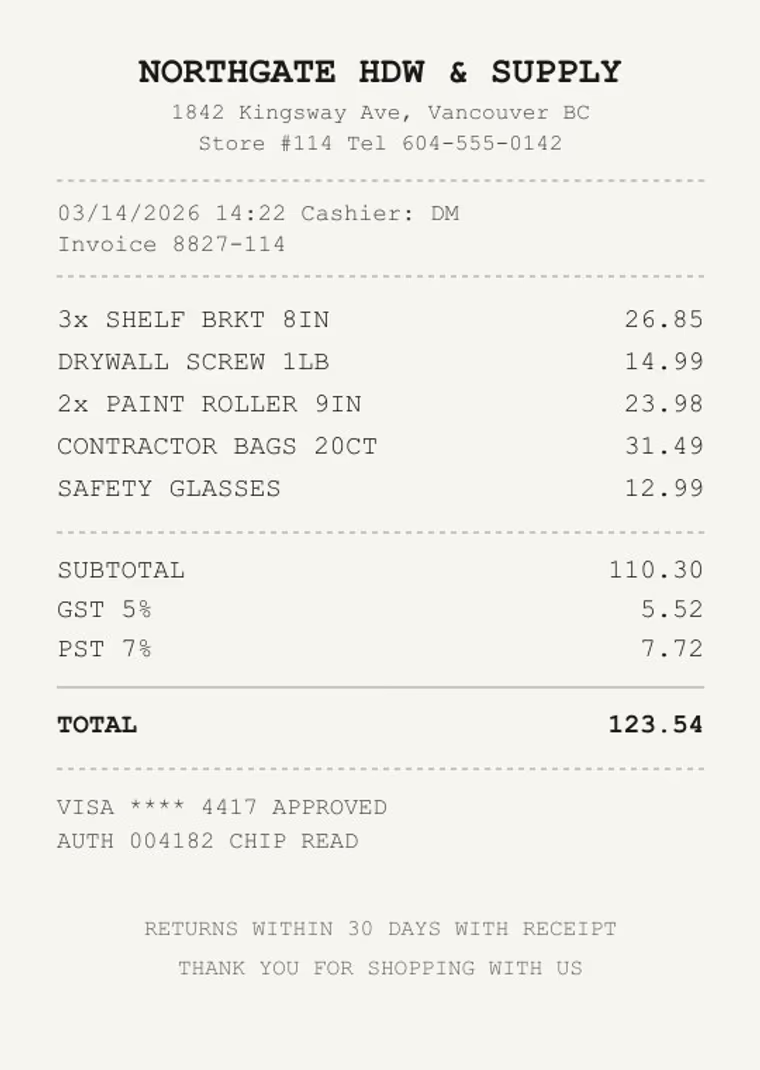
| Field | What the AI returned | Correct? |
|---|---|---|
| Merchant | Northgate Hdw & Supply | Yes |
| Date | 2026-03-14 | Yes |
| Currency | CAD | Yes, and it was not told this |
| Subtotal | 110.30 | Yes |
| Tax lines | GST 5% / 5.52 and PST 7% / 7.72 | Yes, split correctly |
| Total | 123.54 | Yes, and the arithmetic ties |
| Payment | visa, card ending 4417 | Yes |
| Category | office_supplies | No |
| Confidence | 0.95 | Misleadingly high |
Two things in that table are worth dwelling on.
The currency is the impressive part. We passed a hint of USD, and the model overrode it and returned CAD, because the address is in Vancouver and the tax lines are GST and PST. That is contextual reasoning of a kind older tools simply could not do.
The category is the honest part. Shelf brackets, drywall screws, paint rollers, contractor bags and safety glasses are not office supplies. They are materials, and depending on the business they belong in repairs and maintenance, cost of goods sold, or a capital account. The model got it wrong, and it reported 0.95 confidence while doing so.
Where AI bookkeeping fails
That miscategorization is representative rather than unlucky. The failures cluster in the same places.
Ambiguous transactions. A charge at a hardware store could be an expense, an improvement to be capitalized, or something personal. The receipt does not say which, because the answer lives in your intent and your business, not on the paper.
Owner draws versus expenses. A model sees a payment. It cannot reliably tell a distribution from a business cost, and getting this wrong distorts both the profit and loss statement and the owner's tax position.
Sales tax edge cases. Multiple jurisdictions, exempt items, reverse charges and recoverable versus non-recoverable input tax are rule-heavy and change by region. Extraction reads the tax lines correctly far more often than it applies the right treatment to them.
Cut-off. Whether a cost belongs to the month it was paid or the month it was incurred is an accounting judgment, and it is the difference between books that mean something and books that merely balance.
Confident wrongness. The most dangerous failure is not the flagged item, it is the unflagged one. A high confidence score means the model found the pattern familiar, not that the answer is right.
The review layer
This is why the model is not the product. In our service, AI does the extraction and the first-pass categorization continuously, deterministic checks run on top of it, and anything ambiguous is flagged rather than guessed. A licensed CPA then reviews the file, resolves the flags, confirms the reconciliations tie to the statements, and signs off before anything is finalized.
The category error above is exactly the kind of thing that review catches. A CPA looking at a hardware store charge in a contracting business does not need to think hard about whether it is office supplies.
What to ask any AI bookkeeping provider
What is the accuracy figure, and accuracy of what? Extraction accuracy and categorization accuracy are different numbers, and vendors quote whichever is higher. Ask which one they mean.
Who reviews the output, and what are they qualified as? "Expert-reviewed" is not a credential. Ask whether the reviewer is a licensed CPA, and whether review happens on every close or on a sample.
What is the audit trail? You should be able to trace any figure in your financial statements back to the source document. Ask to see that path.
Who is liable if the books are wrong? Read the terms. Many AI-first tools are software, and software licences disclaim responsibility for your financial statements.
What happens to my data, and can I take it with me? Ask whether the ledger lives in your own QuickBooks or Xero file, whether your documents train the vendor's models, and what you keep if you leave.
How Pelcro Approaches AI Bookkeeping
We run the split described above. AI processes invoices, payables, receipts, payroll entries and reconciliations continuously rather than in a month-end scramble, and it flags what it cannot place with confidence instead of guessing. A licensed CPA reviews and signs off every close, at every pricing tier, because the review is the part you are genuinely paying a professional for.
We publish the price rather than quoting it, we work inside your existing QuickBooks Online or Xero file rather than moving you onto something proprietary, and if you leave, the file and the history go with you. You can also test the extraction yourself before speaking to anyone: the receipt scanner and the bank statement converter are free, public, and the same components that run inside the service.
Frequently Asked Questions
Is AI bookkeeping accurate?
Accurate enough for the first pass, not accurate enough to trust unreviewed. In the real extraction above, the model read every figure on the receipt correctly and inferred the currency from context, then assigned the wrong expense category at 0.95 confidence. That pattern, near-perfect on transcription and unreliable on judgment, is what to expect from any AI bookkeeping tool.
Can AI replace a bookkeeper?
It replaces most of what a bookkeeper spends their hours doing, which is data entry, matching and reconciliation. It does not replace responsibility for the books being right, and no model can hold a professional licence. The realistic outcome is not fewer people, it is people spending their time on review and judgment instead of typing.
Is AI bookkeeping safe?
It depends entirely on the provider, so ask rather than assume. The questions that matter are whether your documents are used to train models, where the ledger lives, whether there is an audit trail from statement back to source document, and who carries liability if the numbers are wrong. Any provider unwilling to answer those in writing is answering them.
What does AI bookkeeping cost?
Software-only AI tools start around $25 to $65 a month because you still operate them. Services that include human review start higher, and our own packages are $149, $299 and $499 a month. You can compare the options in our guide to online bookkeeping services or work out your own number with the cost calculator.