
A dunning letter is a notice a business sends to a customer whose payment is overdue or has failed, asking them to pay the balance or update their payment details. Dunning letters are usually sent as a sequence that becomes firmer at each stage, from a friendly reminder to a final notice before service is suspended or the account goes to collections.
This guide is for subscription publishers and finance teams who want to recover more failed payments without damaging the customer relationship. It covers what a dunning letter is, the four stages of a dunning sequence, what each letter should include, sample templates you can adapt, and how Pelcro automates the process.
What Is a Dunning Letter?
A dunning letter is a written request for payment on an account that is past due. The word comes from the 17th-century verb "dun," which means to demand payment of a debt, according to Wikipedia's entry on the dunning process.
Dunning letters are used in two main settings. In B2B accounts receivable, they chase invoices that customers have not paid by the due date. In subscription businesses, they follow a failed card or bank charge, such as an expired card, insufficient funds, or a temporary hold by the issuing bank.
In subscription publishing, dunning letters are almost always automated emails. They are paired with payment retries, which are automatic re-attempts of the failed charge at set intervals, and each message includes a direct link for updating payment information. The goal is to fix the payment before the subscription lapses and the subscriber churns involuntarily.
That goal matters because involuntary churn, meaning churn caused by payment failure rather than a deliberate cancellation, is a large share of the total. Paddle reports that involuntary churn makes up between 20 and 40% of overall churn. A subscriber whose card was declined may still want the publication; they simply did not update their payment method in time.
Dunning letter vs payment reminder vs dunning email
A payment reminder is sent before a payment is due, for example a notice that an annual renewal will be charged in seven days. A dunning letter is sent after a payment has been missed or has failed.
A dunning email is simply a dunning letter delivered by email. B2B collections teams often start with emails and escalate to a formal printed letter, while subscription businesses rely on email, in-app messages, and sometimes SMS for the whole sequence.
The 4 Stages of a Dunning Letter Sequence
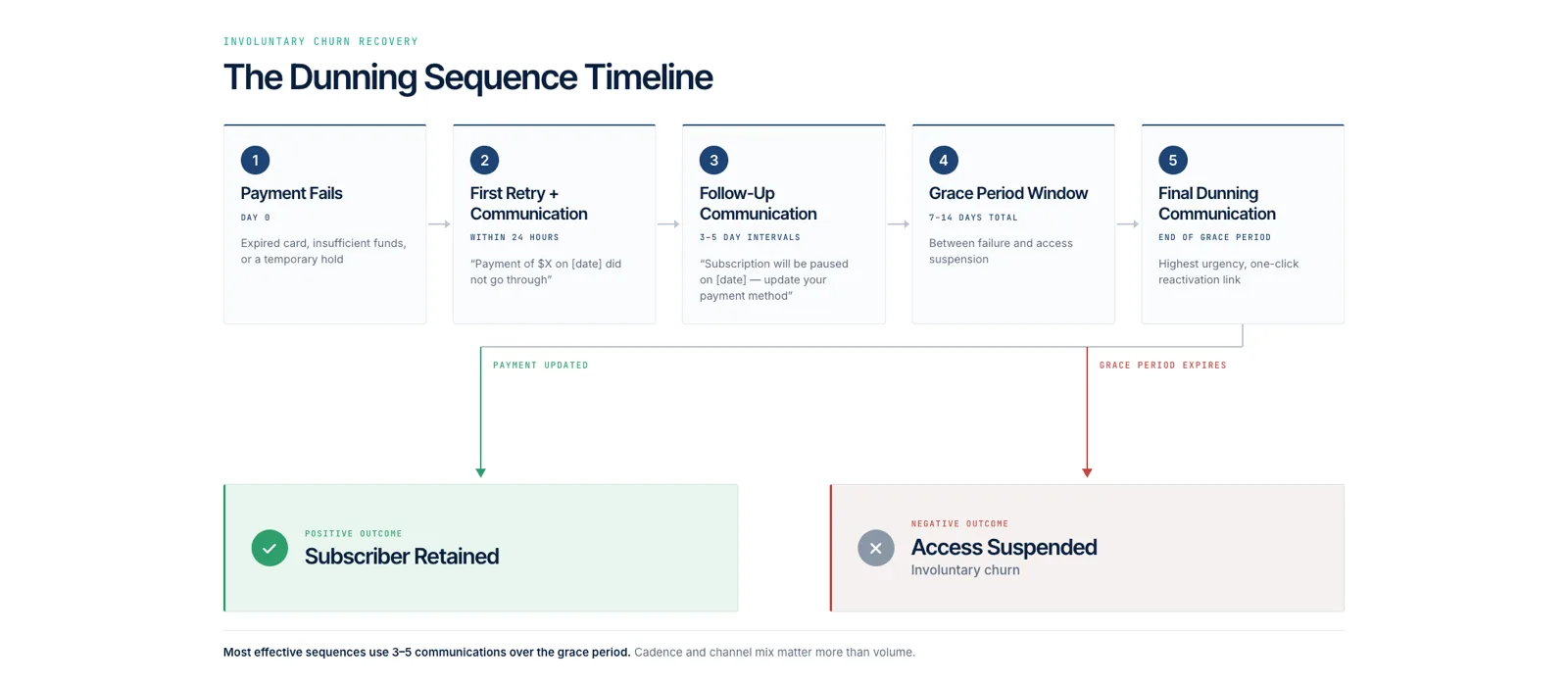
A dunning sequence escalates in tone and consequence at each step. The timing below is a common pattern for a monthly subscription with a 14 day grace period; B2B invoice dunning usually runs over weeks or months instead of days.
| Stage | Typical timing (subscription) | Tone | Main message |
|---|---|---|---|
| 1. Friendly notice | Within 24 hours of the failed charge | Helpful, assumes an honest mistake | Your payment did not go through, here is a link to update it |
| 2. Follow-up reminder | 3 to 5 days later | Clear and direct | Access continues for now, but the balance is still open |
| 3. Warning notice | 7 to 10 days after failure | Firm | Access will be paused on a specific date |
| 4. Final notice | 1 to 2 days before suspension | Urgent but respectful | Last chance to keep the subscription, with a one-click fix |
Timing is the most important variable. The first retry and message should go out within 24 hours, when the failure is most likely temporary and the billing event is still fresh for the subscriber. A sequence that waits a week before its first message loses the window when recovery is easiest.
Grace periods are a configurable retention lever. A grace period that is too short suspends access before the subscriber has had a reasonable chance to respond, while one that is too long removes the urgency that motivates an update.
The final notice is the highest-urgency message in the sequence. Subscribers who respond to it often do so because the consequence of inaction has become concrete, so it should be clear, empathetic, and include a one-click way to fix the payment or reactivate.
What to Include in a Dunning Letter
Every dunning letter should answer three questions: what happened, what happens next, and what the customer should do. A letter that says "Your payment of $X on [date] did not go through," "Your subscription will be paused on [date]," and "Click here to update your payment method" recovers more subscribers than one that is vague or buries the action.
Include these elements in each letter:
- The customer's name and account or subscription details, so the message is clearly about their account.
- The amount due and the original charge or invoice date. For B2B, reference the invoice number and attach a copy.
- The reason, when you know it, such as an expired card.
- The deadline and the consequence, for example the date access will pause.
- A direct payment or update link that works without the customer having to log in and search for billing settings.
- A way to get help, such as a support email or phone number.
Keep the tone professional at every stage. Dunning laws vary by country, and it is generally unlawful to harass or threaten consumers, while firm reminders are acceptable, as Wikipedia's dunning entry notes.
Sample Dunning Letter Templates
The templates below are a generic subscription sequence. Replace the bracketed fields with your own details and adjust the dates to match your retry schedule and grace period.
Template 1: Friendly notice (day 0 to 1)
Subject: Your [Publication] payment didn't go through
Hi [First name],
We tried to charge [amount] for your [plan name] subscription on [date], but the payment didn't go through. This usually happens when a card expires or is replaced.
Your access is not affected. You can update your payment method in under a minute here: [update payment link].
Thanks for reading [Publication], The [Publication] team
Template 2: Follow-up reminder (day 3 to 5)
Subject: Reminder: please update your payment details
Hi [First name],
Your [plan name] payment of [amount] is still outstanding. We'll try the charge again on [retry date], but it will only succeed once your payment details are up to date.
Update your payment method: [update payment link]
Questions? Reply to this email or contact [support email].
Template 3: Warning notice (day 7 to 10)
Subject: Your [Publication] access will pause on [date]
Hi [First name],
We still haven't been able to collect [amount] for your subscription. To avoid an interruption, please update your payment method before [suspension date].
After that date, your access to [Publication] will be paused until the payment is resolved.
Update your payment method: [update payment link]
Template 4: Final notice (1 to 2 days before suspension)
Subject: Final notice: keep your [Publication] subscription
Hi [First name],
This is our last reminder about the [amount] payment for your [plan name] subscription. If we can't collect it by [suspension date], your subscription will be paused.
It takes one click to keep reading: [update payment link]
If you'd like to change your plan instead, you can do that here: [account link].
For B2B invoices, the same four stages apply, but the final notice usually states the next step in writing, such as a late fee, account closure, or referral to a collections agency, in line with your contract terms.
How Pelcro Automates Dunning for Subscription Publishers
Pelcro's dunning system automates the full payment recovery sequence for subscription publishers. When a payment fails, Pelcro starts the configured retry schedule and sends the first dunning communication automatically, with no manual trigger required. Subsequent retries and messages follow the configured sequence until the payment is recovered or the grace period expires.
Publishers configure their dunning sequence in Pelcro's billing settings: the number of retry attempts, the interval between retries, the grace period before access suspension, and the email content for each stage. Dunning emails include a direct link to the subscriber's payment update page, so subscribers can resolve the failure in a single click without contacting customer service.
Pelcro's dunning automation reduces the involuntary churn that would otherwise follow unrecovered payment failures. Every subscriber recovered through dunning is a reader who was already engaged and willing to pay, recovered without any new acquisition cost. For more on the wider problem, see our guide to failed payment recovery.
Frequently Asked Questions
What is a dunning letter in simple terms?
A dunning letter is a reminder that a payment is overdue or has failed, with a request to pay or update payment details. Businesses usually send several dunning letters in a sequence, each one firmer than the last.
What is a dunning letter in publishing?
In subscription publishing, a dunning letter is an automated email sent to a subscriber whose payment has failed, explaining the failure and how to update their payment method. It is part of a broader sequence that combines payment retries with subscriber messages to recover failed payments before the subscription lapses.
How many dunning emails should a publisher send?
Most dunning sequences include three to five messages over the grace period: an initial failure notice, one or two follow-ups, and a final warning before access is suspended. Spacing them 3 to 5 days apart keeps urgency without feeling like harassment.
What percentage of failed subscription payments can dunning recover?
Recovery rates vary with the reason for failure, the timing and quality of the messages, and the length of the grace period. As one reference point, Recurly reports a 25% average recovery rate from dunning across its platform.
What is the difference between dunning and a payment reminder?
A payment reminder is sent before a payment is due, to tell the customer a charge is coming. A dunning letter is sent after a payment has failed or become overdue, to prompt the customer to resolve it.