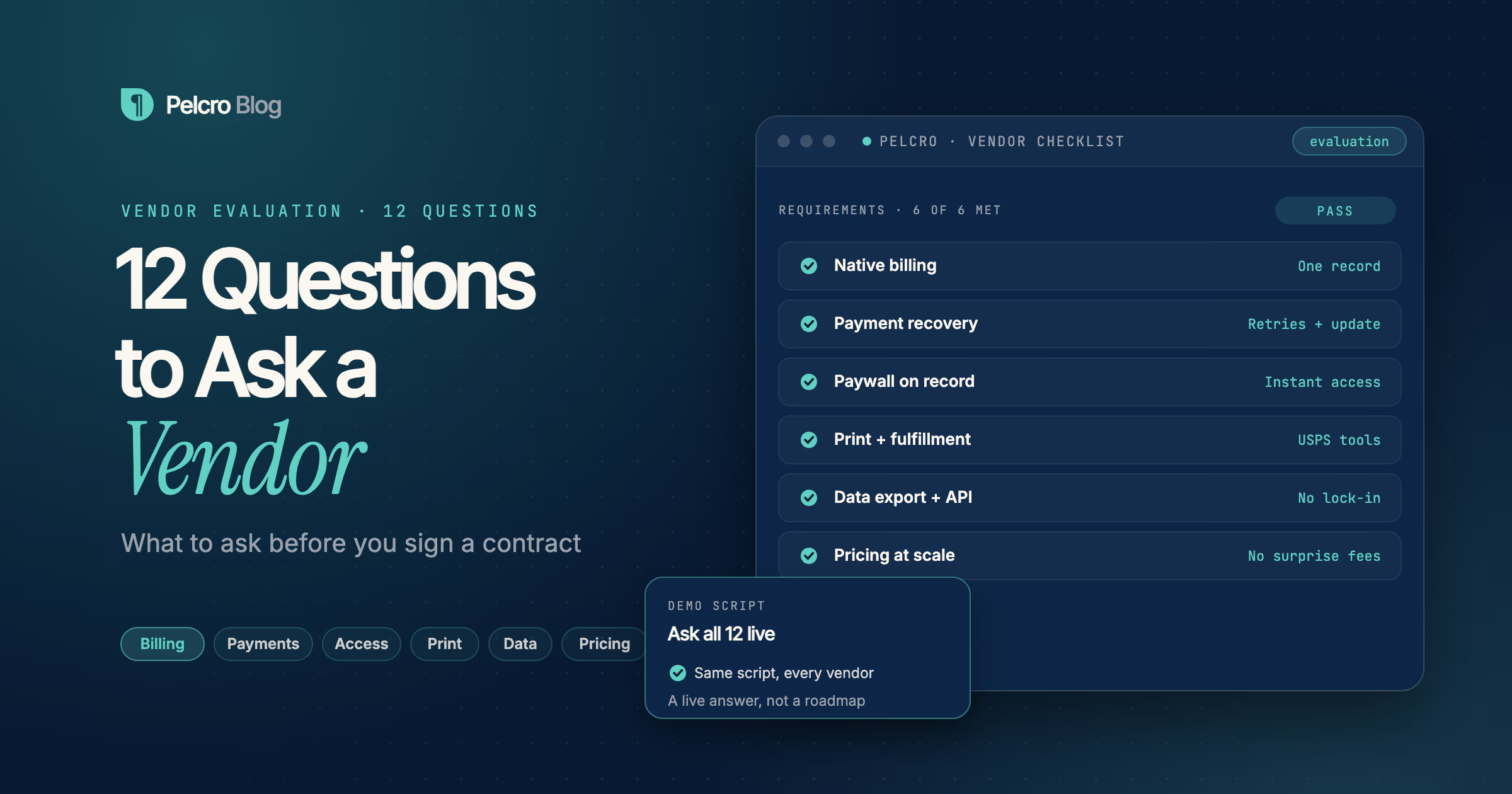
Before you sign with a subscription platform vendor, ask how it handles billing, failed payments, paywalls, print if you need it, migration, data export, and pricing as you grow. The 12 questions to ask a subscription platform vendor below separate the platforms built for publishers from the ones that will cost you a re-platform in two years.
This checklist is for publishers, associations, and membership organizations choosing or replacing a subscription platform. Each question comes with why it matters and what a solid answer sounds like, so you can run the same script across every vendor demo.
What is a subscription platform vendor?
A subscription platform vendor is a company that sells the software you use to sell, bill, and manage subscriptions. For a publisher, that covers the paywall, the checkout, recurring billing, the subscriber record, and often print fulfillment and reporting.
Vendors differ most in how much of that stack they own. Some sell a paywall that plugs into a separate billing system, some sell billing that needs a separate paywall, and some run the whole contract-to-cash flow on one platform. The questions below exist to find out which kind you are actually buying.
The risk in this decision is switching cost. Moving subscribers, payment tokens, and billing history between platforms is slow and error-prone, so the goal is to choose a vendor you will not have to leave when you grow or add print. Our guide to the best subscription management software for publishers compares the main options side by side.
12 questions to ask a subscription platform vendor
Ask all of these during a demo, and push for a live answer rather than a roadmap promise.
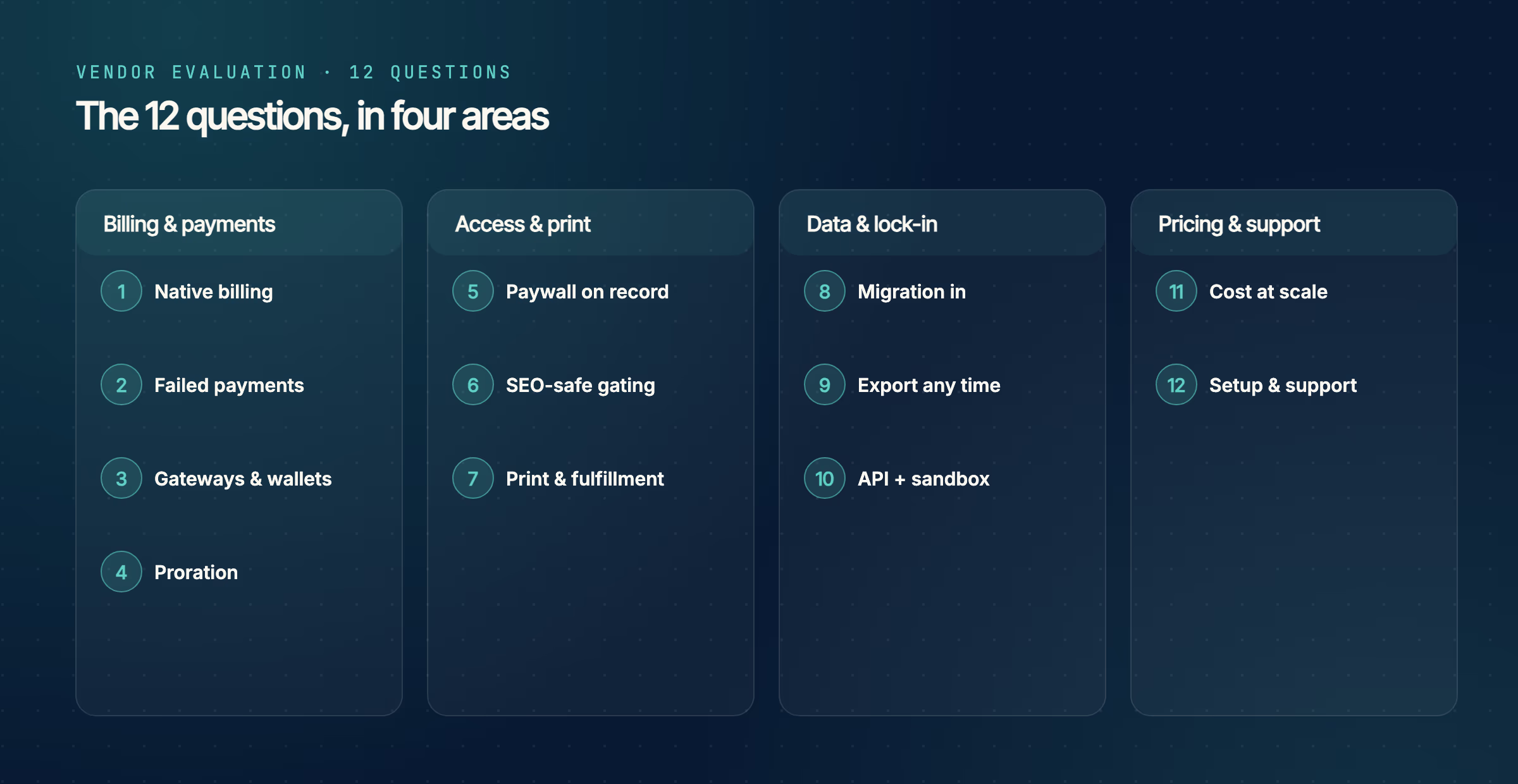
Billing and payments
1. Does billing run natively, or through a separate system? A native billing engine means one subscriber record for access and payments. A vendor that connects to a separate biller adds a system to reconcile and a seam where data drifts.
2. How do you recover failed payments? Ask about retries, dunning emails, and card-update prompts. Involuntary churn from expired cards is one of the largest quiet revenue leaks, so a vendor without an automatic recovery process is leaving money on the table.
3. Which payment gateways and methods do you support? Check for your current processor, multiple currencies, and wallets like Apple Pay and Google Pay. Being locked to one gateway limits your pricing and your geography.
4. How are mid-cycle plan changes prorated? Upgrades, downgrades, and monthly-to-annual switches should be billed fairly without manual math. Confirm the behavior with a case like the one in the proration calculator.
Access, paywalls, and print
5. Is the paywall part of the platform or a separate product? A paywall on the same record as billing recognizes a paying subscriber on every device instantly. A disconnected wall is where "I paid but I'm still locked out" tickets come from.
6. Do gated pages stay indexable by search engines? Good platforms let crawlers read gated articles or mark them with structured data, so the paywall does not cost you search traffic.
7. Can you handle print subscriptions and fulfillment? If you sell print, ask whether circulation, address validation, and mail-file export are native, done through partners, or not offered. This one question decides how many systems your team logs into.
Data, migration, and lock-in
8. How do we migrate subscribers and payment tokens in? Ask who does the work and whether saved cards transfer without re-asking subscribers to pay again. A vendor that cannot import payment tokens forces a painful re-entry.
9. Can we export all of our data, any time? You should be able to pull customers, subscriptions, and invoices on demand. If export is gated or manual, that is a lock-in signal.
10. Is there an API and a test environment? An API and a sandbox let your team build and verify integrations before they touch live subscribers. Without them, every integration change is a gamble on production.
Pricing and support
11. What will this cost at our size in three years, including fees? Ask for the price at your projected subscriber count, and whether there is a revenue share on top of a subscription fee. Revenue-share pricing grows with your success in a way flat tiers do not.
12. Who implements it, and what does support look like after launch? Ask whether onboarding is self-serve or hands-on, and what your team can reach after go-live. For publishers without an in-house dev team, this answer matters as much as the feature list.
How Pelcro answers these questions
Pelcro runs billing, the paywall, the subscriber portal, and print fulfillment on one platform, so most of the questions above have a single answer: it is on the same record. Pricing tiers are on the pricing page, and anything specific to your setup is covered in a demo call.
Payments run through multiple gateways and currencies, plan changes prorate automatically, and failed renewals go through payment recovery with retries and card-update prompts. Because the paywall sits on that same record, a paying subscriber is recognized on every device, and search crawlers are detected so gated pages stay indexable.
For data, Pelcro exposes an API and a test environment, and migration and export are scoped with your team during onboarding. Print subscriptions and fulfillment, including USPS address tools, run natively rather than on a separate circulation system. For a side-by-side view of the field, read subscription management software for publishers and paywall plugins vs subscription management platforms.
Frequently Asked Questions
What is the most important question to ask a subscription platform vendor?
Ask whether billing, the paywall, and the subscriber record are one system or several connected ones. The answer shapes almost every other cost, from reconciliation to support tickets, because disconnected systems are where subscriber data drifts.
How do I compare subscription platform vendors fairly?
Run the same checklist in every demo and ask for a live answer rather than a roadmap promise. Then compare total cost at your projected size in three years, not just the headline price, since revenue-share pricing and fees change the picture.
What questions reveal vendor lock-in?
Ask how you would migrate in, whether saved payment cards transfer, and whether you can export all your data on demand. A vendor that makes it hard to leave usually makes it hard to import in the first place.
Should publishers ask about print during a subscription platform demo?
Yes, if you sell print now or might later. Ask whether circulation, address validation, and mail-file export are native, partner-based, or missing, because adding print to a digital-only platform later often means running a separate system.