
Billed in arrears means a customer is invoiced after the service period has been delivered, not before it starts. For example, a customer who uses a service from March 1 to March 31 receives the invoice on April 1 and pays it on the agreed terms.
This guide is for finance and billing teams at subscription businesses that need to bill in arrears without hurting cash flow or month-end close. It covers how billing in arrears works, a dated example, how it compares with billing in advance, its pros and cons, and how to manage it.
What is billed arrears?
For finance teams managing recurring revenue, billed arrears means invoicing a customer after the service period has already started or ended, rather than collecting payment upfront. In practice, that could look like a monthly subscription billed on the last day of the month for usage already delivered, or a quarterly contract charged after the quarter closes.
Billed arrears helps companies align invoices with actual service delivery, which can improve customer trust and make usage-based billing easier to explain. It also affects cash flow timing, accounts receivable, collections, and revenue recognition, so finance teams need clean systems and consistent rules to keep reporting accurate.
Some businesses still handle billed arrears in spreadsheets or through legacy ERP workflows, but those approaches can break down quickly when contracts change, mid-cycle upgrades happen, or billing has to scale across multiple products and entities. Pelcro stands apart by connecting subscription management, automated invoicing, and revenue workflows in one platform, so billing in arrears does not turn into a reconciliation problem at month-end.
In subscription businesses, billed arrears is often used when the final charge depends on consumption, access history, or completed service periods. That makes it especially useful for media, SaaS, memberships, and other recurring models where the invoice needs to reflect what was actually delivered.
How does billed arrears work in subscription billing?
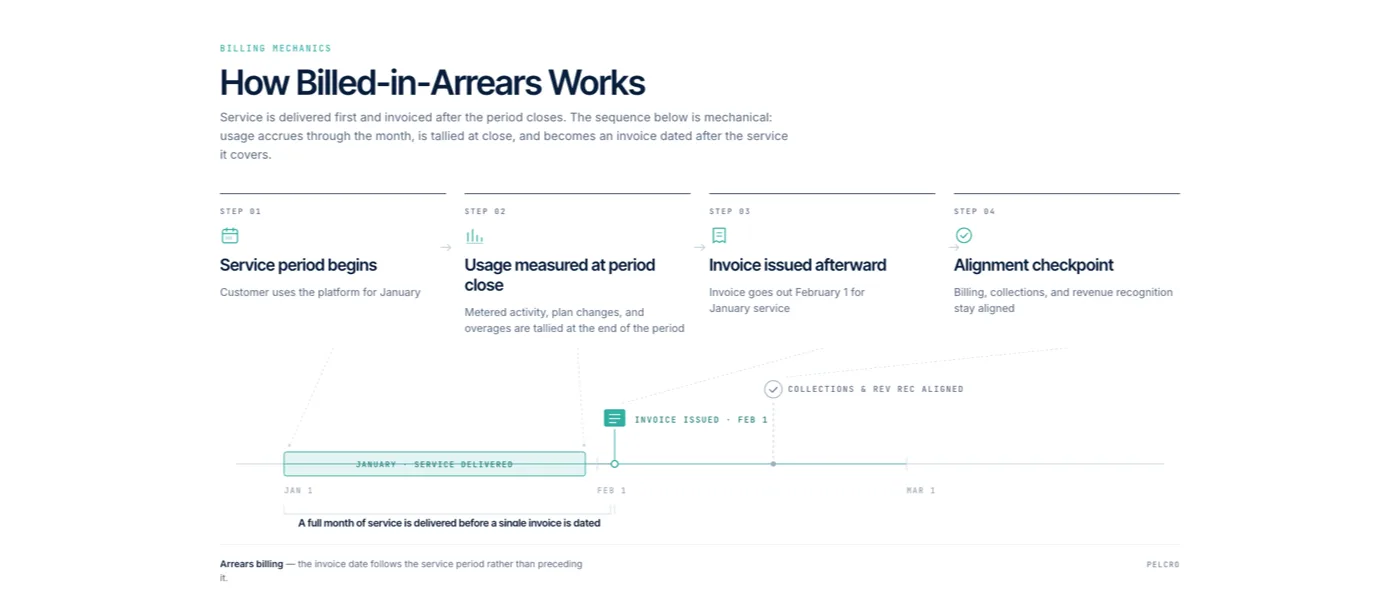
Billed arrears works by separating the service period from the billing date. A customer receives the service first, then gets invoiced afterward, which means the accounting team records the obligation as the period unfolds and the invoice only when the cycle closes.
The basic pattern is straightforward. If a customer uses a platform for January, the invoice may go out on February 1 for January service. If usage varies, the amount billed can depend on metered activity, plan changes, or overages that are measured at the end of the period.
The biggest advantage of billed arrears is accuracy. Companies can match charges to actual delivery, which reduces disputes and supports clearer reporting. The tradeoff is operational complexity, because billing, collections, and revenue recognition must stay aligned even when subscriptions start, pause, renew, or expand.
To manage billed arrears well, teams need reliable contract data, automated invoice generation, and audit-friendly records. Without that, it becomes easy to miss usage, invoice the wrong period, or delay revenue recognition close processes.
A dated example of billing in arrears
Here is how one monthly cycle looks when you bill in arrears on net 30 payment terms.
| Step | Date | What happens |
|---|---|---|
| Service period starts | March 1 | The customer gets access. No invoice is sent yet. |
| Service period ends | March 31 | Usage, seats, or delivered units for March are final. |
| Invoice issued | April 1 | The invoice covers March service only. |
| Payment due | May 1 | Net 30 from the April 1 invoice date. |
In this example, the business delivers a full month of service before it invoices, then waits another 30 days for payment. That gap of up to 61 days between the first day of service and the due date is the core cash flow cost of billing in arrears.
Under accrual accounting, revenue for March is generally recognized in March, when the service is delivered, even though the invoice goes out in April. Until the invoice is issued, finance teams usually carry that amount as accrued or unbilled revenue, then move it to accounts receivable on the invoice date.
Common examples of billing in arrears
Billing in arrears shows up anywhere the final amount is only known after delivery. Utilities bill for the electricity or water already used, and phone carriers add data overages after the cycle closes.
Payroll is another familiar case. Employees are often paid in arrears, meaning they receive pay for a period they have already worked.
In media and subscription businesses, arrears billing fits corporate or site licenses that true up seat counts after a period, advertising invoiced after a campaign runs, and content licensing or syndication fees based on what was actually used. Usage-based SaaS products also bill in arrears for metered consumption.
Billing in arrears vs billing in advance
Billing in advance means invoicing before the service period starts, so the customer pays first and receives service second. Billing in arrears is the reverse: service first, invoice second.
| Billing in advance | Billing in arrears | |
|---|---|---|
| Invoice timing | Before the service period | After the service period |
| Example (March service) | Invoice on March 1 | Invoice on April 1 |
| Cash flow | Cash arrives early and is predictable | Cash arrives later and depends on collections |
| Amount billed | Fixed or estimated price | Actual usage or delivered service |
| Accounting entry before service | Deferred revenue (a liability) | Accrued or unbilled revenue (an asset) |
| Credit risk | Low, the customer has already paid | Higher, the customer may pay late or not at all |
| Typical fit | Flat-rate subscriptions, annual plans | Usage-based pricing, true-ups, services |
Most consumer subscriptions, such as a monthly digital news subscription, bill in advance because the price is fixed and access starts immediately. Billing in arrears makes more sense when the amount cannot be known until the period closes.
Many companies run a hybrid model. A fixed platform fee is billed in advance, while overages, extra seats, or usage are billed in arrears on the same invoice for the prior period.
Pros and cons of billing in arrears
The main advantages of billing in arrears are accuracy and customer trust. Customers pay for what they actually received, which reduces disputes, credit notes, and refund requests.
It also lowers the barrier to signing up. A customer who does not pay upfront takes on less risk, which can help win larger or more cautious accounts.
The tradeoffs are cash flow and risk. The business funds the service period itself, carries more accounts receivable, and is exposed if a customer pays late or defaults.
Billing in arrears also adds work. Usage must be captured accurately, invoices must reference the right period, and plan changes during the period must be prorated correctly.
How to manage billing in arrears
These practices reduce the cash flow and collection risk of billing in arrears:
- Put payment terms in the contract. State the billing period, invoice date, due date (such as net 15 or net 30), and any late fee policy before service starts.
- Shorten the billing cycle when risk is high. Monthly arrears billing exposes less revenue than quarterly arrears billing if a customer stops paying.
- Ask for a deposit or advance fee on large accounts. A partial upfront payment or a fixed fee billed in advance offsets the exposure of the usage billed in arrears.
- Automate invoice generation at period close. Invoices should go out on the first day after the period ends, using contract and usage data rather than manual entry.
- Automate reminders and collections. Send reminders before and on the due date, then a structured follow-up sequence, such as dunning letters, when a payment is missed.
- Reconcile unbilled revenue every close. Check that accrued revenue for each period turns into an invoice, so nothing delivered goes unbilled.
How Pelcro handles billed arrears
Pelcro helps companies manage billed arrears by bringing subscription management and billing automation into the same workflow. That means contract changes, proration, invoicing, and renewals can all flow through a system designed for recurring revenue instead of being patched together across disconnected tools.
With Pelcro, finance teams can automate invoicing based on the correct billing schedule and keep customer records tied to the real contract terms. This reduces manual entry, limits billing errors, and makes it easier to support both predictable subscriptions and more complex usage-based arrangements.
Pelcro also supports the broader contract-to-cash process, which matters when billed arrears affects more than just invoices. From billing and collections to revenue recognition, the platform helps teams maintain a cleaner handoff between operations and finance, so month-end close is less dependent on manual spreadsheet work.
For companies growing across products, markets, or member types, that consistency matters. Pelcro gives teams a centralized way to manage the billing logic behind billed arrears while keeping customer experiences smooth and finance reporting dependable.
Frequently Asked Questions
What does billed arrears mean in billing?
Billed arrears means the customer is invoiced after the service has been delivered for the billing period. It is common in subscriptions, memberships, and usage-based pricing models.
Is billed arrears the same as paying in arrears?
They are closely related, but the wording often depends on context. Billed arrears usually refers to when the invoice is issued, while paying in arrears refers to when payment is due after service delivery.
Why do companies use billed arrears?
Companies use billed arrears to match invoices with actual service delivered, reduce billing disputes, and support more accurate revenue operations. It can be especially helpful when usage varies from month to month.
Does billed in arrears mean a payment is late?
No. In billing, "in arrears" describes when the invoice is issued, after the service period. Outside billing, "in arrears" can also mean a debt is overdue, which is why the term is sometimes confused with late payment.
What is the difference between billing in arrears and billing in advance?
Billing in advance charges the customer before the service period begins, while billing in arrears charges after it ends. For March service, an advance invoice goes out on March 1 and an arrears invoice goes out on April 1.
What are the risks of billed arrears?
The main risks are delayed cash collection, billing mistakes, and messy revenue recognition if systems are not connected. Automation and strong billing controls help reduce those problems.