
A material weakness is a control deficiency severe enough that there is a reasonable possibility a material misstatement of the financial statements will not be prevented or detected on time. A significant deficiency is less severe than that, but still important enough to merit the attention of whoever oversees financial reporting, usually the audit committee.
This guide is for controllers, finance leads, and audit committee members who need to classify a control finding correctly. It covers the official PCAOB and SEC definitions, a side-by-side comparison table, illustrative examples, and the remediation steps that move a finding back to clean.
What is the difference between significant deficiency and material weakness?
The difference between a significant deficiency vs material weakness comes down to severity: how likely a misstatement is, and how large it could be. Both sit on the same ladder, which starts with an ordinary control deficiency and ends with a material weakness.
The PCAOB defines all three terms in Appendix A of AS 2201, the standard for auditing internal control over financial reporting (ICFR). The SEC uses the same definitions of material weakness and significant deficiency in Regulation S-X Rule 1-02, so management and the auditor are working from one vocabulary.
The official definitions
Control deficiency (AS 2201.A3). A deficiency exists "when the design or operation of a control does not allow management or employees, in the normal course of performing their assigned functions, to prevent or detect misstatements on a timely basis." A design deficiency means a needed control is missing or would not meet its objective even when performed. An operating deficiency means a well-designed control is not performed as designed, or the person performing it lacks the authority or competence to do it well.
Significant deficiency (AS 2201.A11). A deficiency, or a combination of deficiencies, in ICFR "that is less severe than a material weakness, yet important enough to merit attention by those responsible for oversight of the company's financial reporting."
Material weakness (AS 2201.A7). A deficiency, or a combination of deficiencies, in ICFR "such that there is a reasonable possibility that a material misstatement of the company's annual or interim financial statements will not be prevented or detected on a timely basis." The standard adds that a reasonable possibility exists when the likelihood is either "reasonably possible" or "probable" under the contingencies guidance now codified in ASC 450.
Significant deficiency vs material weakness: comparison table
| Level | Definition (short form) | Likelihood and magnitude | Who the auditor must inform | Public disclosure |
|---|---|---|---|---|
| Control deficiency | A control's design or operation does not allow staff to prevent or detect misstatements on time | Any misstatement it could allow is not severe enough to escalate | Management, in writing, with the audit committee told the communication was made (AS 2201.81) | Not required |
| Significant deficiency | Less severe than a material weakness, but merits the attention of those overseeing financial reporting | Could lead to a misstatement that matters, but not a reasonably possible material one | Audit committee, in writing, before the ICFR report is issued (AS 2201.80) | Not required in the annual ICFR report; certifying officers must disclose it to the auditors and audit committee (SOX Section 302) |
| Material weakness | A reasonable possibility that a material misstatement will not be prevented or detected on time | Reasonably possible or probable, and material in size | Management and the audit committee, in writing, before the ICFR report is issued (AS 2201.78) | Must be disclosed in management's ICFR report; ICFR cannot be called effective (Regulation S-K Item 308) and the auditor issues an adverse ICFR opinion (AS 2201.90) |
Two points in that table catch teams out. First, severity does not depend on whether a misstatement actually happened, only on whether there is a reasonable possibility the controls would fail to catch one (AS 2201.64). Second, several deficiencies that touch the same account or disclosure can add up to a material weakness even when each one alone looks minor (AS 2201.65).
How do you distinguish significant deficiency vs material weakness?
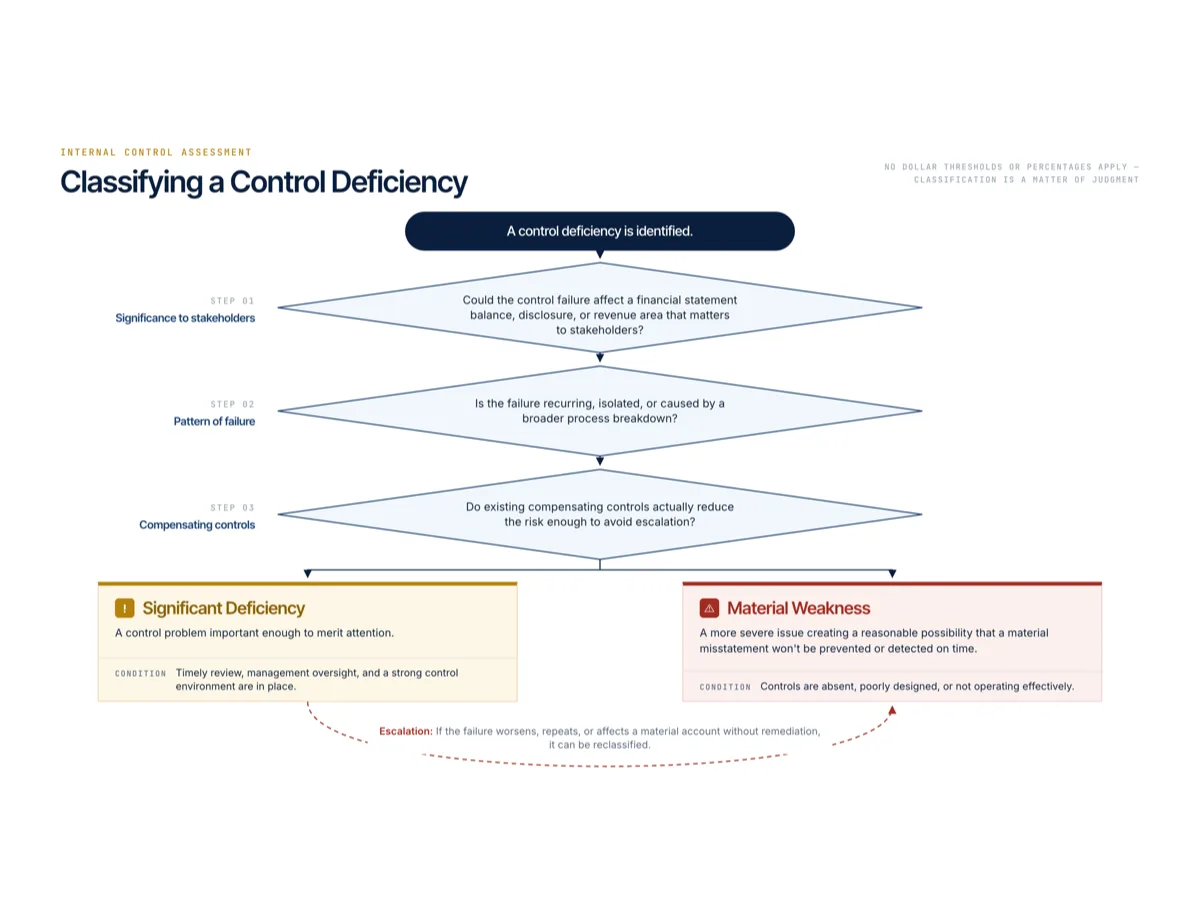
AS 2201.63 says the severity of a deficiency depends on two things. The first is whether there is a reasonable possibility that controls will fail to prevent or detect a misstatement. The second is the magnitude of the potential misstatement.
Likelihood factors
Paragraph .65 lists risk factors that push likelihood up. They include the nature of the accounts and assertions involved, how susceptible the asset or liability is to loss or fraud, and how much judgment or complexity goes into the amount. The interaction with other controls, the interaction between deficiencies, and the possible future consequences also count.
The standard notes that the likelihood call can be made without putting a percentage on it. That leaves room for judgment, which is why documentation of the reasoning matters as much as the conclusion.
Magnitude factors
Paragraph .66 says magnitude depends on the dollar amount or total of transactions exposed to the deficiency, and the volume of activity that has run or will run through the affected account. For an overstatement, the ceiling is generally the recorded amount, while understatements could be larger (AS 2201.67).
Compensating controls
A compensating control can keep a deficiency below the material weakness line, but only if it is precise enough. AS 2201.68 says it must operate at a level of precision that would prevent or detect a misstatement that could be material. A high-level monthly review that would only spot a large swing rarely clears that bar.
Indicators of a material weakness
AS 2201.69 names four indicators that point strongly toward a material weakness:
-
Fraud on the part of senior management, whether or not it is material.
-
A restatement of previously issued financial statements to correct a material misstatement.
-
The auditor finding a material misstatement in the current period that the company's controls would not have caught.
-
Ineffective oversight of external financial reporting and ICFR by the audit committee.
If any of those is present, the starting assumption should be material weakness, and the burden shifts to explaining why it is not.
A practical classification test
Finance teams can work through the same sequence the standard implies. Ask what account, disclosure, or assertion the control protects, and how much flows through it. Then ask whether the failure is isolated or systemic, and whether a precise compensating control would still catch an error that matters.
Finally, apply the prudent official test in AS 2201.70. If the deficiency might stop prudent officials from concluding they have reasonable assurance that transactions are properly recorded under GAAP, the auditor should treat it as an indicator of a material weakness.
Illustrative examples
The scenarios below are hypothetical and simplified to show how the factors interact. They are not drawn from any real company, and a real classification always depends on the full facts and auditor judgment.
Illustrative control deficiency. A manager signs off on a monthly bank reconciliation two weeks late in one quarter, but the reconciliation itself was complete and accurate. The misstatement risk is low and a separate cash review would catch large differences, so it likely stays a control deficiency.
Illustrative significant deficiency. A subscription business lets billing staff edit plan prices without a second approval, but finance reviews every revenue journal against signed orders each month. The gap is real and deserves audit committee attention, while the precise downstream review limits how large an undetected error could grow.
Illustrative material weakness. The same business has no review of contract modifications, and its revenue schedules are rebuilt by hand in spreadsheets each quarter. Revenue is its largest account and involves judgment under ASC 606, so a material misstatement going undetected is reasonably possible.
How to remediate a significant deficiency or material weakness
Remediation follows a predictable path, and the evidence trail matters as much as the fix. A typical sequence looks like this:
-
Find the root cause. Separate design failures from operating failures, because a missing control and a skipped control need different fixes.
-
Write a remediation plan. Give each action an owner, a deadline, and a reporting line to the audit committee.
-
Redesign or add the control. Fix the gap at the source where possible, for example by automating a manual handoff rather than adding another review.
-
Let the control run. A new control needs enough cycles of operation to show it works, so build that time into the plan.
-
Test and document. Management tests the remediated control, keeps the evidence, and internal audit or the external auditor can then test it independently.
-
Keep governance informed. Report status to the audit committee through each stage, not only at the end.
For SEC registrants, timing matters. Under Regulation S-K Item 308, management cannot call ICFR effective if a material weakness exists at fiscal year end, so a fix that has not yet run and been tested by then may not change the conclusion.
How Pelcro supports control accuracy and audit readiness
Many control findings in subscription businesses start in the handoffs between billing, payments, and the general ledger. Pelcro connects subscription management, automated billing, payment collection, and revenue recognition on one record, which removes several of the manual steps where those findings tend to appear.
When contract data flows directly into invoices and revenue schedules, there is less spreadsheet rework to control. Pelcro's finance reports, including the revenue waterfall, A/R aging, and payment reconciliation, trace each figure back to the subscription, invoice, and customer behind it. That gives auditors evidence for how a transaction was authorized, billed, and recognized.
That traceability also helps when a finding does appear. Teams can isolate whether the issue sits in one plan, one period, or one process, test the control against the records, and decide with evidence whether it is a significant deficiency vs material weakness.
Frequently Asked Questions
What is the main difference between significant deficiency vs material weakness?
A material weakness creates a reasonable possibility that a material misstatement will not be prevented or detected on time. A significant deficiency is less severe than that, but still important enough to merit the attention of those overseeing financial reporting, such as the audit committee.
Who decides whether a control issue is a significant deficiency vs material weakness?
Management makes its own assessment of ICFR, and the external auditor evaluates severity independently under PCAOB AS 2201. Both look at likelihood, magnitude, and whether compensating controls are precise enough to catch a material error.
Does a significant deficiency have to be disclosed publicly?
Regulation S-K Item 308 requires public disclosure of material weaknesses in management's annual ICFR report, but it has no parallel requirement for significant deficiencies. Significant deficiencies still go in writing to the audit committee, and certifying officers must disclose them to the auditors and audit committee under SOX Section 302.
Can a significant deficiency become a material weakness?
Yes. A deficiency can be reclassified if it worsens, recurs, or combines with other deficiencies affecting the same account or disclosure. AS 2201 specifically says multiple deficiencies can add up to a material weakness even when each one alone is less severe.
Why does billing automation matter in control assessments?
Manual billing and spreadsheet revenue schedules add steps where controls can fail, and each step needs its own evidence. Automating those handoffs reduces the number of controls to test and leaves a cleaner audit trail when a finding needs to be investigated.