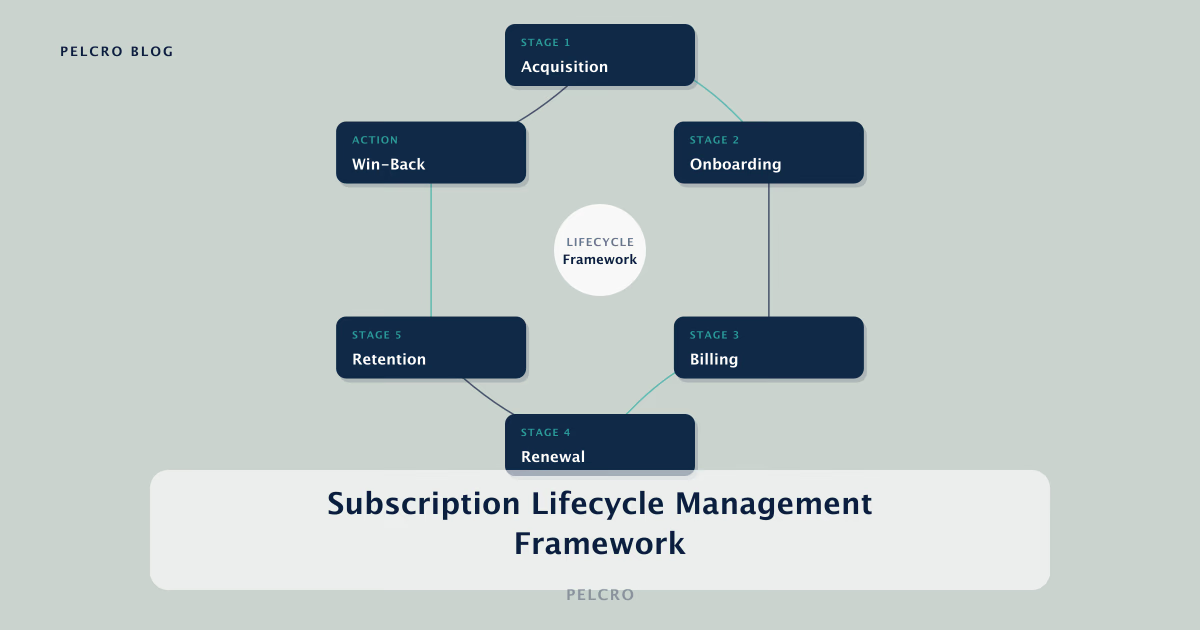
For teams trying to reduce churn and grow recurring revenue without guesswork, a subscription lifecycle management framework gives every stage of the subscriber relationship a defined process instead of ad hoc decisions made stage by stage.
This guide breaks down the stages a subscription lifecycle management framework should cover, how to build one for your business, and how Pelcro runs every stage on a single subscriber record instead of a patchwork of disconnected tools.
A subscription lifecycle management framework maps out what should happen at acquisition, onboarding, billing, renewal, and win-back, so every team knows exactly what triggers each stage and what happens next.
What Is a Subscription Lifecycle Management Framework
A subscription lifecycle management framework is a defined set of stages, triggers, and actions that govern how a subscriber moves through their relationship with a product, from first signup to eventual cancellation or renewal. A publisher without a subscription lifecycle management framework tends to handle each stage reactively, deciding case by case how to respond to a trial ending or a payment failing, rather than following a consistent process.
For a subscription business, a subscription lifecycle management framework turns scattered decisions into a repeatable system. Instead of a support agent improvising a response to a failed payment, the framework defines exactly what happens: a retry attempt, a grace period, a dunning email, and an access change if the payment never succeeds. That consistency is what makes churn and retention numbers predictable rather than a surprise every month end.
Many businesses have pieces of a subscription lifecycle management framework without realizing it, a billing retry policy here, an onboarding email there, but no single document or system ties the stages together. A proper subscription lifecycle management framework treats the whole subscriber journey as one connected process, not a collection of unrelated point fixes.
How to Build a Subscription Lifecycle Management Framework
Start by mapping the stages. A complete subscription lifecycle management framework typically covers acquisition, onboarding, activation, billing and renewal, retention and win-back, and offboarding. Write down what should happen at each stage before deciding which tools will execute it.
Next, define the triggers. A subscription lifecycle management framework only works if each stage has a clear trigger, a trial ending, a payment failing, a renewal date approaching, that moves a subscriber from one stage to the next automatically rather than depending on someone noticing.
Then assign the actions. For every trigger in your subscription lifecycle management framework, decide the exact action: a specific email, a grace period length, an access change, or an escalation to a human. Vague stages like "follow up with the customer" are not a framework, they are a hope.
Finally, build in measurement. A subscription lifecycle management framework should report on how subscribers move through each stage, where they drop off, and which interventions actually reduce churn, so the framework improves over time instead of staying static.
How Pelcro Powers This Framework
Pelcro runs every stage of subscription lifecycle management on one subscriber record, so acquisition, billing, entitlements, and renewal are not separate systems that need to be kept in sync manually.
Sign-up flows and paywalls handle acquisition and onboarding, automated recurring and usage-based billing handles the billing and renewal stages, and entitlement rules update access the moment a subscriber's status changes, whether that is an upgrade, a failed payment, or a cancellation. AI-assisted insights flag subscribers at risk of churn early, so the retention and win-back stage of the framework has a trigger to act on instead of waiting for a cancellation request.
Because every stage shares the same data, a subscription lifecycle management framework built on Pelcro reports accurately on where subscribers actually drop off, whether that is a failed payment during renewal or a trial that expires without activation, giving a team the measurement piece most frameworks lack when they run on disconnected tools.
Frequently Asked Questions
What stages does a subscription lifecycle management framework cover?
Most frameworks cover acquisition, onboarding, activation, billing and renewal, retention and win-back, and offboarding. A subscription lifecycle management framework defines what triggers each stage and exactly what action follows, rather than leaving it to case-by-case judgment.
Why do businesses need a subscription lifecycle management framework instead of just billing software?
Billing software handles one stage. A subscription lifecycle management framework governs the entire relationship, including onboarding, retention, and win-back, with billing as one connected piece rather than the whole system.
How does a subscription lifecycle management framework reduce churn?
By defining a consistent, automatic response to churn signals like a failed payment or an expiring trial, instead of relying on someone noticing and reacting manually. A subscription lifecycle management framework turns retention into a repeatable process rather than a scramble.
Can a subscription lifecycle management framework be automated?
Yes, and it should be. Pelcro runs the triggers and actions of a subscription lifecycle management framework automatically, from billing retries to entitlement updates, so the framework executes consistently without a team manually monitoring every subscriber.