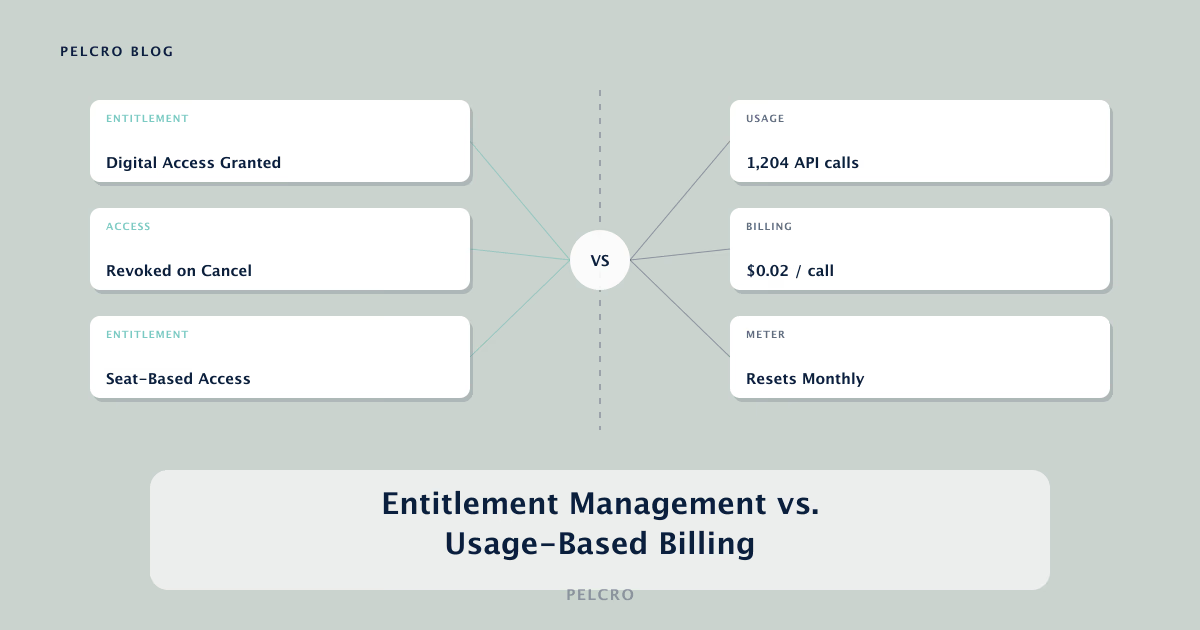
For product and finance teams building a subscription business around metered access, entitlement management and usage-based billing solve two different problems that are easy to confuse.
This guide breaks down what each system actually does, how entitlement management compares to usage-based billing in practice, and how Pelcro connects the two so access and charges never drift apart.
Entitlement management controls what a subscriber can access; usage-based billing controls what they pay for using it, and a subscription business needs both working from the same data to avoid giving away access it never bills for.
What Are Entitlement Management and Usage-Based Billing
Entitlement management is the system that defines, enforces, and tracks what each subscriber is allowed to access based on their plan. If a subscriber pays for a metered API plan, entitlement management is what confirms they are allowed to call that API at all, separate from how much each call costs them.
Usage-based billing is the system that measures consumption, usually in units like API calls, articles read, or seats active, and turns that consumption into a charge. Where entitlement management answers "can this subscriber access this," usage-based billing answers "how much do they owe for what they used."
The two are related but distinct. A subscriber can have entitlement to access a feature while usage-based billing tracks how much of it they consume and charges accordingly. Systems that conflate the two often end up either blocking access that should be billed, or billing usage that was never actually entitled, both of which create support tickets and revenue leakage.
Entitlement Management vs. Usage-Based Billing: The Key Differences
Entitlement management is a permissions layer. It checks, at the moment a subscriber tries to read an article, call an API, or open a feature, whether their current plan allows it. It updates the instant a plan changes, a trial expires, or a payment fails, independent of how much the subscriber has used so far.
Usage-based billing is a metering and pricing layer. It counts consumption over a billing period and calculates a charge, often with tiers, overage rates, or included allowances. It does not decide whether access should be granted; it assumes access has already been confirmed and focuses purely on what to charge for it.
In practice, the two need to talk to each other constantly. When entitlement management revokes access after a failed payment, usage-based billing needs to stop metering usage for that account. When usage-based billing detects a subscriber has hit a plan's included limit, entitlement management may need to gate further access until they upgrade. Systems that run these as separate, unconnected tools end up with subscribers who are billed for access they no longer have, or who access features nobody is billing them for.
How Pelcro Connects Entitlement Management and Usage-Based Billing
Pelcro's digital rights and entitlement management runs on the same data layer as its billing engine, so entitlements and usage-based charges stay in sync without custom integration work. When a subscriber's plan changes, their access updates immediately, and any usage-based charges tied to that plan reflect the change on the very next invoice.
Publishers use Pelcro to gate content and features by plan tier through no-code entitlement rules, while the underlying billing engine handles usage-based, recurring, and one-off charges in the same system. A subscriber on a metered plan gets exactly the access their entitlements allow, and exactly the invoice their usage generates, with no manual reconciliation between the two.
This matters most at the edges: grace periods after a failed payment, mid-cycle upgrades, and usage overages. Because entitlement management and usage-based billing share the same subscriber record, Pelcro can hold access open during a grace period without under-billing, or immediately gate a feature the moment a usage cap is hit, without a separate sync job running on a delay.
Frequently Asked Questions
Is entitlement management the same as usage-based billing?
No. Entitlement management controls what a subscriber can access based on their plan. Usage-based billing measures how much they consumed and calculates a charge. A subscription business typically needs both, connected to the same subscriber record, rather than one standing in for the other.
Do I need entitlement management if I already have usage-based billing?
Yes, if you want to control access separately from charging for it. Usage-based billing alone will meter and bill consumption, but without entitlement management there is no clean way to instantly revoke or grant access when a plan changes or a payment fails.
How do entitlement management and usage-based billing work together for API products?
Entitlement management confirms a subscriber's plan allows API access at all, while usage-based billing counts each call and calculates the charge, often with included allowances and overage tiers. Together they let a business gate access by plan and bill precisely for consumption within it.
What happens to usage-based billing when entitlement management revokes access?
Well-connected systems stop metering usage the moment entitlement management revokes access, whether from a cancellation, a failed payment, or a plan downgrade. If the two systems are not connected, a subscriber can keep generating usage-based charges after they should have lost access, which creates billing disputes.