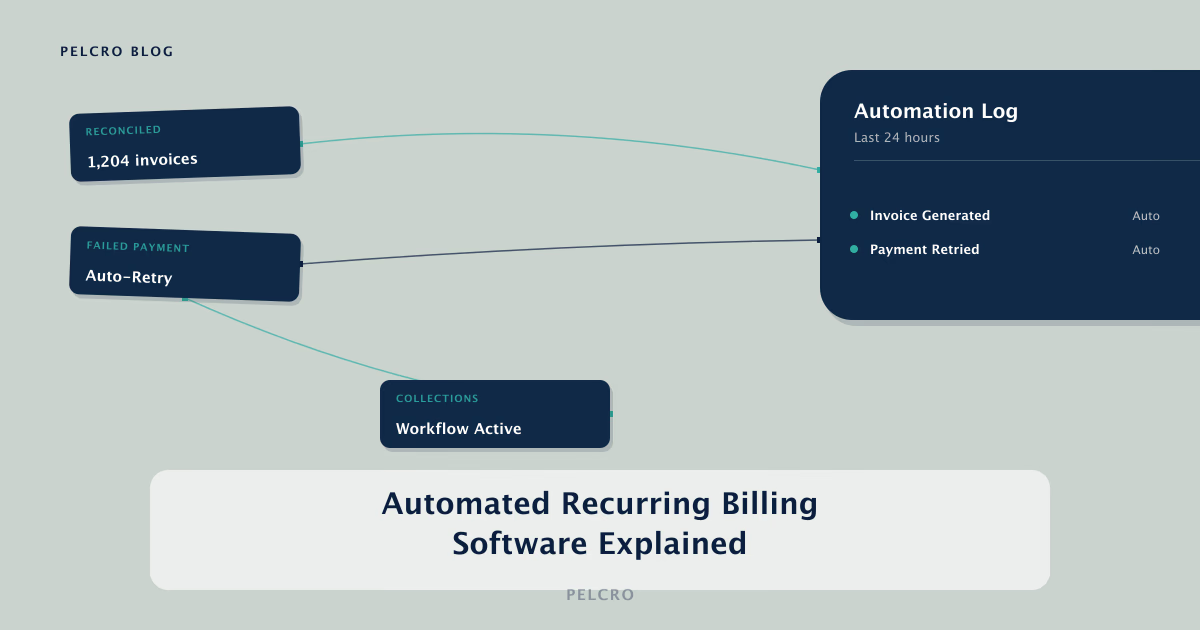
For finance teams still creating invoices and chasing late payments by hand, automated recurring billing software is what turns a manual monthly scramble into a workflow that runs itself.
This guide breaks down what automated recurring billing software actually removes from a finance team's plate, how the automation works end to end, and how Pelcro's accounts receivable automation handles the full billing lifecycle without manual intervention.
Automated recurring billing software generates invoices, tracks payments, and manages collections on its own schedule, so a finance team only steps in for the exceptions a system genuinely cannot resolve.
What Is Automated Recurring Billing Software
Automated recurring billing software is a system that generates invoices, charges customers, tracks payments, and follows up on overdue balances without a person triggering each step manually. A subscription business billing thousands of customers on staggered monthly and annual cycles needs automated recurring billing software that fires the right invoice on the right date for every customer, every time.
For a finance team, automated recurring billing software removes the hours spent manually creating invoices, tracking payments, and reconciling transactions across spreadsheets and accounting systems. Those disconnected, manual workflows are exactly where delays, errors, and cash flow uncertainty creep in, and they scale badly as a customer base grows.
Many billing tools automate the invoice itself but leave collections and reconciliation manual, which means finance still spends its time chasing late payments after the automated invoice goes unpaid. Automated recurring billing software done well automates the entire lifecycle, not just the moment the invoice gets created.
How Automated Recurring Billing Software Actually Works
The automation starts with invoice generation. Automated recurring billing software watches each customer's billing cycle and generates the correct invoice, whether it is a flat recurring charge, a usage-based charge, or a one-off fee, on the date it is due, with no manual trigger required.
From there, it tracks the payment outcome automatically. Automated recurring billing software knows immediately whether a charge succeeded, failed, or is still pending, and updates the customer's account and balance accordingly without a finance team member checking a dashboard.
When a payment fails or a balance goes overdue, automated recurring billing software should move that account into a collections workflow on its own, sending reminders and retrying the charge on a schedule rather than waiting for someone to notice the invoice is unpaid.
Finally, it reconciles. Automated recurring billing software ties every invoice back to the payment that settled it, so month-end close does not require manually matching transactions across a payment processor, a spreadsheet, and an accounting system.
If your accounting system is QuickBooks, see how to automate Pelcro payments and invoices in QuickBooks.
How Pelcro Solves This
Pelcro's accounts receivable automation automates the entire accounts receivable lifecycle, from generating and sending invoices to tracking payments, collections, and reconciliation, so subscription businesses get paid faster with fewer errors.
This is automated recurring billing software built to remove the manual work that slows finance teams down: no more manually creating invoices and tracking payments in spreadsheets, no more chasing late payments one account at a time, and no more reconciliation errors from stitching together data across disconnected systems. Pelcro streamlines recurring and usage-based revenue collections so the automation covers the full billing cycle, not just the invoice.
Because invoicing, payment tracking, and collections all run on the same platform, automated recurring billing software can move a customer from a fresh invoice to a completed collection without a finance team member touching a single step, unless the account genuinely needs a human decision.
For subscription businesses with recurring, usage-based, and one-off charges mixed across the same customer base, that end-to-end automation is what keeps cash flow predictable instead of dependent on how quickly someone gets to a spreadsheet each week.
Frequently Asked Questions
What does automated recurring billing software actually automate?
It automates invoice generation, payment tracking, collections follow-up, and reconciliation, covering the full billing cycle rather than just the moment an invoice is created. Good automated recurring billing software leaves a finance team handling only genuine exceptions.
Does automated recurring billing software handle late payments on its own?
Yes, in strong implementations. Automated recurring billing software should move an overdue account into a collections workflow automatically, sending reminders and retrying failed charges on a schedule instead of waiting for a person to notice.
How does automated recurring billing software reduce reconciliation errors?
By tying every invoice to the payment that settles it inside one system. Automated recurring billing software that keeps invoicing and payment tracking on the same platform removes the manual spreadsheet matching that causes most reconciliation errors.
Is automated recurring billing software the same as invoice automation?
They overlap but are not identical. Invoice automation focuses on generating invoices correctly. Automated recurring billing software goes further, covering payment tracking, collections, and reconciliation as part of the same automated accounts receivable lifecycle.