You didn’t lose your traffic. It was quietly repackaged and delivered by AI.
While everyone was busy arguing about whether AI should train on publisher data, something else happened. Chatbots learned how to rebuild your articles without ever touching your servers.
They don't scrape.
They don’t leave footprints.
They just stitch together pieces of your reporting from tweets, Reddit posts, newsletters, cached summaries and hand it over to the reader in seconds.
No click. No paywall. No trace.
This guide breaks down how that’s unfolding, what it’s costing publishers, and what you can do to respond.
Anatomy of Digital Dismantling: How AI Reconstructs Premium Content
The chatbot doesn't magically pierce through your paywall. Instead, it becomes a digital detective, gathering clues from everywhere your content has left traces.
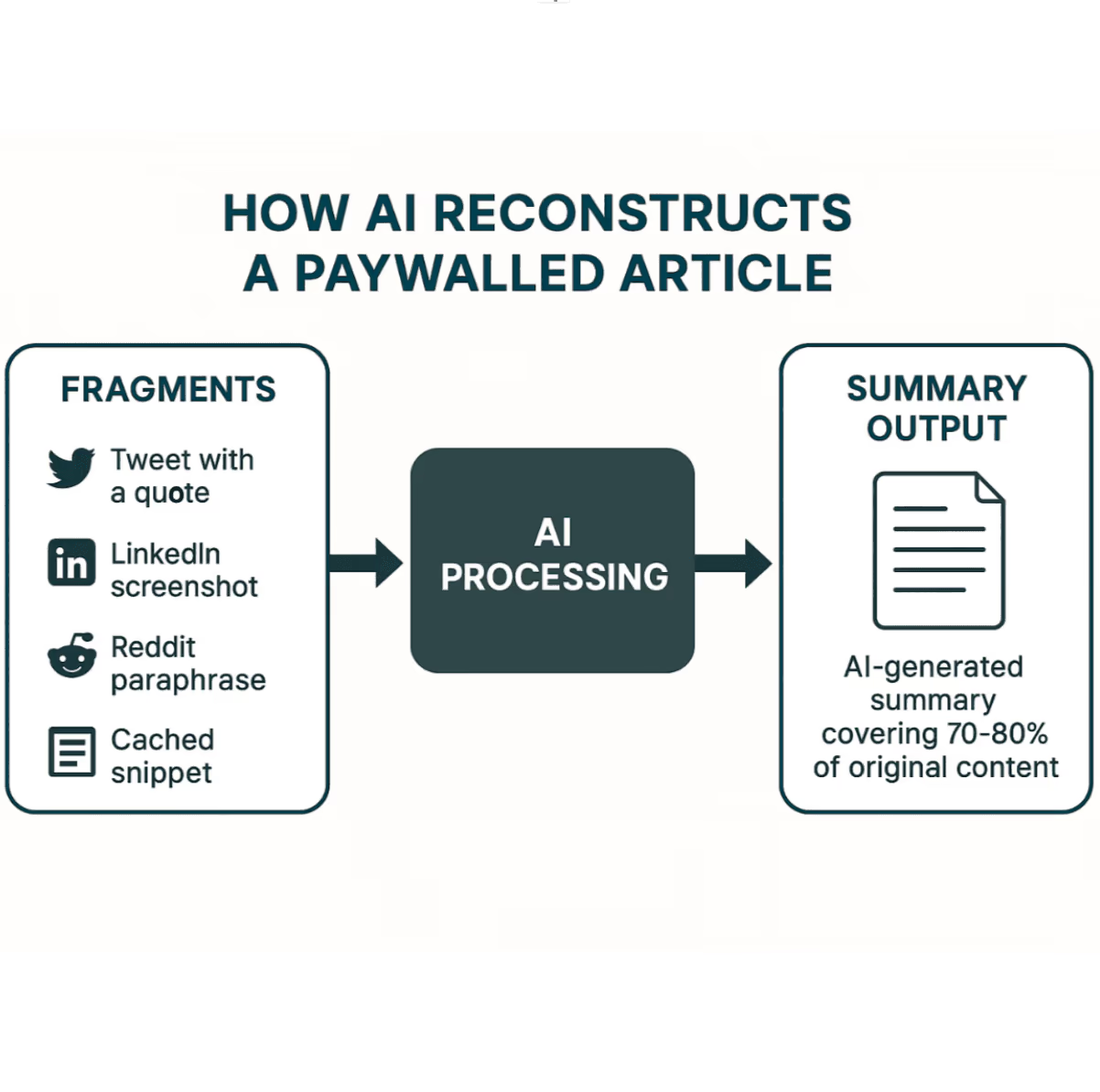
Your article about the latest tech merger gets quoted in a tweet. Someone screenshots your opening paragraph and shares it on LinkedIn. A Reddit user paraphrases your main argument in a discussion thread. Industry analysts reference your findings in their own reports. Each fragment becomes a puzzle piece.
The AI assembles these pieces with frightening accuracy. It fills gaps using pattern recognition from similar stories you've published before. It makes educated guesses about your conclusions based on your publication's historical stance on similar issues. And the result is a summary that captures 70-80% of your article's value without anyone ever visiting your site.
This fragment reconstruction works especially well for breaking news, where multiple sources often cover similar ground. The AI can triangulate between public statements, social media reactions, and competing coverage to rebuild your exclusive reporting.
The technical differences between direct access and content synthesis make this incredibly hard to combat. There's no IP address to block, no bot signature to detect. The AI never touches your servers, never triggers your analytics, and never leaves a digital footprint on your site.
How AI Is Affecting Publisher Reach
Let's talk about what this is actually costing you. The numbers are stark, and they're getting worse every quarter.
Traffic to the world’s 500 most visited publishers has dropped between 20% and 27% year-over-year since February 2024, according to Similarweb data. This represents an average loss of 64 million visits per month across the industry. Meanwhile, AI chatbots delivered fewer than 1 million referrals per month between January and May 2024, with that number reportedly increasing to over 25 million in 2025. In other words, publishers are losing significantly more traffic than the referrals AI chatbots currently generate.
The New York Times saw referral traffic drop 27.4% in Q2 2025, and a 36.3% drop on 2024 election days vs 2020. CNBC has lost 10–20% of its search-driven traffic. Recent reports show that Google AI Overviews have slashed referral traffic by as much as 70%, while chatbots like ChatGPT and Claude often send zero referral traffic at all.
The Enders Analysis report found that half of all publishers experienced declining search traffic over the past year, with AI overviews directly cannibalizing website visits. Zero-click searches, where users get their answers without ever visiting your site, are becoming the norm rather than the exception.
Four Common Reader Behaviours That Bypass Paywalls
Your readers aren't trying to hurt you, but they've discovered AI makes paywall circumvention almost effortless. Understanding their methods helps you grasp the scope of the challenge you're facing.
1. Asking for a Direct Summary
The simplest and most common method. A user types something like: “Can you summarize the article ‘The Future of Remote Work’ from Harvard Business Review?” AI pulls together a response using cached previews, public comments, related coverage, and previously quoted excerpts.
2. Mining Social Media Fragments
Platforms like X and Reddit are full of screenshots, quotes, and paraphrased content from paywalled articles. AI tools like Grok are trained to scan these platforms, collecting scattered pieces to rebuild the original article’s message.
3. Requesting Bullet Point Takeaways
Instead of full summaries, users often ask for quick takeaways. Prompts like “Give me the key points from the latest WSJ article on inflation” lead AI to generate concise, accurate bullet points, especially if the article sparked widespread discussion online.
4. Reconstructing Academic or Technical Content
Professionals frequently ask AI tools to “recreate the argument” of locked journal articles. AI pulls from abstracts, citations, previous papers, and commentary to assemble a convincing version of the original content.
Most users don’t see this as bypassing or stealing but they see it as a smarter way to stay informed.They ask once, get what they need instantly, and move on without ever considering the impact on subscriptions, traffic, or original publishers.
How do you protect content that needs to be discoverable enough to attract readers but hidden enough to prevent AI reconstruction?
Bot blocking in the traditional sense has evolved significantly, with Cloudflare implementing default bot blocking on new domains and developing pay-per-crawl opt-in models for AI firms. TollBit reported blocking 26 million scraping attempts in March 2025 alone, while Cloudflare saw bot traffic jump from 3% to 13% in a single quarter. AI honeypots represent a clever defensive approach. These systems lure bots into dead-end decoy pages, helping publishers identify and block AI crawlers. However, these measures only stop direct scraping, not content reconstruction from public fragments.
Some publishers are experimenting with content watermarking and unique phrasing designed to make unauthorized reproduction more detectable. Others are implementing sophisticated tracking systems to monitor where their content appears in AI responses, though enforcement remains challenging.
As publishers develop new defenses, AI systems become more sophisticated at working around them. The fundamental challenge remains: how do you protect content that needs to be discoverable enough to attract readers but hidden enough to prevent AI reconstruction?
Business Model Transformation: From Traffic-Dependent to Direct-Audience
The most successful publishers are abandoning traffic-dependent models entirely. Instead of chasing search engine optimization and social media algorithms, they're building direct relationships with readers who value their brand specifically.
Dotdash Meredith provides the clearest success story for this approach. The company achieved revenue growth in Q1 2024, a rare feat in today's publishing landscape. CEO Neil Vogel revealed that Google Search now accounts for just over a third of their traffic, down from around 60% in 2021. This big change toward direct audience cultivation has insulated them from AI-driven traffic losses.
The pivot requires fundamental changes in how you think about content and audience. Instead of optimizing for search keywords and viral potential, successful publishers focus on building trust, expertise, and community around their brand. They're creating content that readers specifically seek out rather than stumble across.
Publishers are adjusting their subscription strategies to reflect the growing influence of AI tools that can summarize or reconstruct content. This change includes:
New value propositions that AI cannot replicate, such as:
-
Exclusive interviews.
-
Behind-the-scenes access.
-
Community-driven features.
-
Personalized content experiences.**
Brand Building Over SEO Dependency:
Brand building is replacing SEO-heavy strategies as a core growth engine.Even ad-supported giants like Mail Online and The Sun are: Introducing partial paywalls and aiming to protect revenue streams from declining anonymous traffic.
What’s Happening Legally: Lawsuits, Licensing, and a Lot of Grey Areas
The legal side of this issue is still taking shape, but here’s what we know so far:
-
The NYT vs. OpenAI case is the biggest one on the table.It’s not about AI summarizing articles: it’s about training data. But the outcome will set the tone for how courts view AI companies using publisher content.**
-
**Some publishers are going the licensing route. Deals with The Associated Press, Future Publishing, and others show one possible path. These agreements give AI firms access to content in exchange for compensation.But right now, only a small group of publishers are covered.
-
**There’s no global standard. What’s protected in one country might not be in another.For publishers with international audiences, this creates real challenges, especially since AI systems don’t respect borders.
-
**Copyright law isn’t built for this.If AI tools are reconstructing your content from fragments found online, it’s hard to argue they’ve “copied” anything in the traditional legal sense.Existing laws weren’t designed to handle this kind of indirect usage.
You Can’t Wait for the Courts to Catch Up
Legal battles take years. AI moves in months.
-
If you’re hoping for a clear ruling before taking action, it’s probably going to be too late.
-
The best approach now is to focus on defensive strategies that work today, even if the legal rules are still uncertain.**
What’s Coming Next: Three Ways This Could Play Out
The way things are going, we’re heading toward one of three outcomes and each has serious consequences for publishers.
**1. Consolidation:**The big players survive. Publishers with strong brands, multiple revenue sources, and legal teams will keep going. Smaller ones may not make it.
**2. Coexistence:**AI companies and publishers work out fair licensing deals, like what happened in the music industry with streaming. In this version, AI can still function, but publishers get paid properly for their content.
**3. Disruption:**The old model may collapse, because AI doesn’t just summarize content , it creates it. Journalists might shift into roles like prompt designers or AI editors. Subscriptions and ad models fade out.
Why These Defences Might Not Be Enough
AI tools are getting better at reconstructing paywalled content by using fewer public clues to deliver more complete summaries. Even if your current defences are working now, they likely won’t keep up for long.
Can Governments Step In?
Some policymakers are talking about protecting journalism by possibly treating AI firms like utilities that must pay content creators fairly. But regulation usually moves slower than tech, so this may not come in time.
The Ball’s Still in AI’s Court
AI companies have real influence over how this plays out. They could:
-
Set up fair licensing programs
-
Build systems that drive users back to original sources
-
Share revenue with content creators
Whether they choose to do that and how soon, will show what publishing looks like over the next decade.
Want to Know If AI Is Using Your Content?
We’ve created a free guide that walks you through 6 simple ways to test whether your paywalled content is being reconstructed by AI tools like ChatGPT, Claude, or Perplexity.
Inside, you’ll learn:
-
How to prompt AI tools to test for content leakage
-
What signs to look for in AI-generated summaries
-
How to use social media and search to trace content fragments
-
What patterns suggest your article has been reverse-engineered
-
How to monitor AI forums and usage threads
-
Lightweight tools and methods to run ongoing checks**
📥 Fill out the form below to get instant access to the full guide.
Frequently Asked Questions
How can I tell if an AI chatbot is reconstructing my paywalled content?
Look for detailed summaries that capture your article's main arguments but lack specific quotes, exact data points, or recent information that would only be available in the full article. AI reconstructions often feel slightly vague or generalized compared to direct quotes from your actual content. Monitor social media and forums for discussions about your articles, as these provide the fragments AI systems use for reconstruction.
What's the difference between AI scraping and paywall circumvention?
Scraping involves AI systems directly accessing and extracting your content, which appears in your server logs and can be blocked with technical measures. Circumvention reconstructs your content from publicly available fragments like social media posts, cached snippets, and related coverage. The AI never touches your servers, making it much harder to detect and prevent.
Can technical solutions completely stop AI paywall bypass?
No single technical solution provides complete protection because AI reconstruction doesn't require direct access to your content. Traditional defenses like bot blocking help with direct scraping but offer limited protection against fragment-based reconstruction. The most effective approach combines technical measures with content strategy changes and business model adaptations.
What role do search engines play in this problem?
Search engines enable circumvention through AI overviews and zero-click results that answer user queries without driving traffic to source sites. However, they remain important traffic sources for many publishers. The challenge lies in maintaining search visibility while protecting content value. Search engines are also developing licensing programs and exploring ways to better compensate content creators.